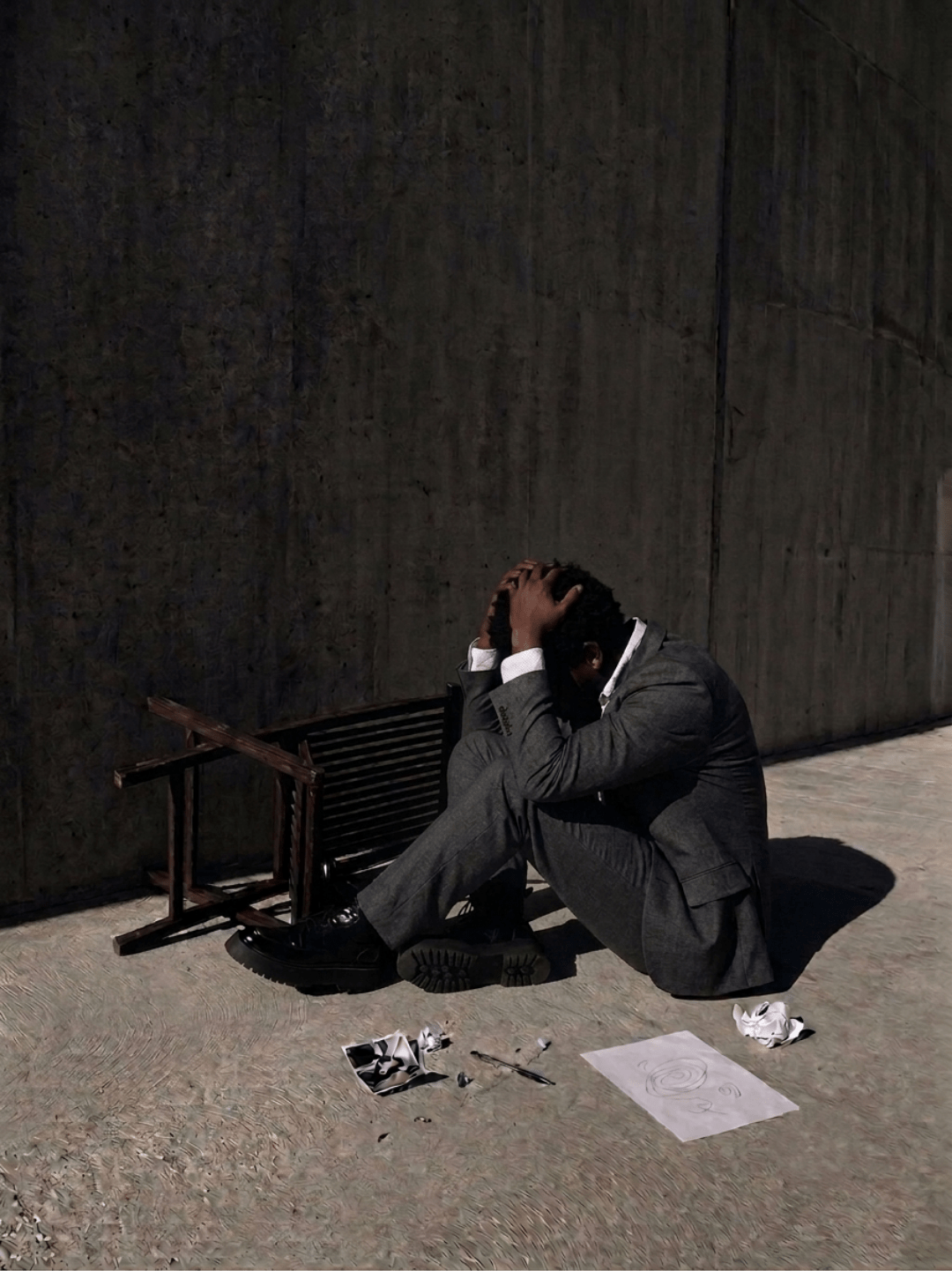
A psychological rupture lingers longer than a long day.
Introduction by Terry-Jo Thorne (Researcher)
Poems selected by Alex Gwaze (Curator)
We all carry trauma from different places, with different tools — but what we share is the tendency to turn inward even while pointing outward at the cause. One moment becomes everything: a riot, a court record, a still life. We try to locate ourselves in time and logic while the mind resists, reconstructing the breakdown from the middle rather than looking back from safe distance. The damage sits differently in each of us — one rages, one confronts, one simply observes what remains. But the destination we seek is the same. Not to find that we are lost, but to discover we have already left for the journey ahead. We know we are broken. We are not who we thought we were — and we must decide what comes next. We cannot stay here. This is a bad place.
Therapy For A King
BY SCRAH MDALA
Zimbabwean writer, educator, director & poet who won the Best Production award at the Jika International Theatre Dance Festival, and Stop to Start International writing contest winner. Known for pioneering film and theatre productions including Hotel Khumalo, 6th Avenue, 1894, The Life of Lobengula, and Behind Closed Doors — Zimbabwe’s first R-rated play.
I have always been civil,
but now they see me evil.
Evil like a phone battery dying mid-call.
Evil like a lion that got tired of pretending it’s a lamb.
They undermined me —
or maybe just underpaid me.
All I know is I overworked my spirit
like a generator with no oil.
Then they put me on bipolar medicine.
Not because I’m born
like that, no, no, no.
Because of my seizures, they must put a lid on my brain
like somebody locking a pot before the boiling starts.
First meds suppressed my fire.
Cool, I can live with that.
Then later, they changed the story.
Now I’m sleepy like a prophecy I can’t finish reading.
I acted intentionally —
here’s to breaking all English laws
because my mind is
breaking all rules.
Have I become bipolar not because of genetics,
but because of strain
Stress like the taste of iron in your mouth.
Stress like a drum beating inside a locked chest.
I walked kilometres alone one morning.
Like I was trying to outrun my own thoughts.
Like my brain is a thief
and I’m the only guard on duty.
Insomnia — that sneaky night ghost that sits on one’s chest like it pays rent.
Maybe I’m crazy after all.
Maybe I’m mad.
Maybe I’m both.
Maybe I’m the kind of mad that smiles first,
then bites later.
But all I want is wisdom, like Solomon —
a king with 700 wives and 300 concubines
who knows when to cut a baby in half.
I hate that I was strong
for far too long.
I hate that I smiled while my nervous system
bled.
I hate that I kept being
reasonable while my
body started writing threats in bloody Latin.
Hate is not holy.
But sometimes hate is the only clean knife left in the drawer.
If you see me quiet, don’t assume I’m healed.
If you see me laughing, don’t assume it’s easy.
If you see me standing, don’t assume I’m stable.
This is medicine.
Or maybe just misery shaking hands in public.
But I’m back like a drum that refuses retirement.
Turning this pain into punctuation.
Turning this hurt into a rhythm.
Turning this madness into a mouth that bites back.
I will not go insane quietly.
I will go insane loudly,. on purpose —
with fire in the mix, with truth in the noise,
with victory hiding inside a joke.
I didn’t ask for this war.
But if my mind cannot be trusted,
I will trust my voice.
And my voice will return — roaring.
This is not the end of me.
It’s a pregnancy.
A rebirth.
A riot in slow motion.
I call it return.
I call it ignition.
I call it fire.
I call it bloody truth
I Don’t Blame Me
BY TAKUNDA MUSINGWINI
Zimbabwean medical student, poet & songwriter — published under the name “The Pen.” Co-author of Dancing in the Shadows, an anthology that won Best Poetry Anthology at the Poetry Red Carpet Awards. Future Life Now award winner, Midlands Writers and Book Culture collective runner-up, and Poetry Red Carpet Awards Best Page Poet nominee. An active mentor to emerging young writers.
I’m cognisant
it’s Monday, 08 July,
Fully conscious
1100hrs
I’m in control,
I know I am!
Rage? Screeching violence?
Who — me?
I’m confounded,
I-I don’t understand.
I adore Maphoe
with overflowing passion.
Every deed I do aims to make me her mainstay.
Her eyes — I would bleed for them
to look up and see
hope, happiness,
Strength …
Me.
Yet you’re standing there,
barking —
I hurt her.
Who?
It can’t be.
I never could.
Never.
I’m human to her.
I’m loved.
It’s only ever been her.
I remember the last whispers
that echoed before I slept,
Your voice and Mom’s:
“He’s a cancer.”
Then — boom.
Cuts mapped across my skin,
Blood where answers should be.
And suddenly,
I’m accused
Of hurting my own sister.
Astounding!
Truly astounding.
I’m aware that you
never saw me as your son.
Only through me,
Searching for the man who broke you.
He was sick.
I’m not him.
He hurt you.
I didn’t.
So why?
Why do you look at your own blood
And see something to hate?
Is it the echo of a wife’s broken desire?
A longing for perfection
that my existence disrupts?
A wound buried so deep
it still bleeds through me?
Or is it simply easier to blame?
I blame you.
I don’t blame me.
You robbed me.
You owe me my life.
Every blackout.
Every episode.
Every fracture I’ve endured,
You inscribed.
Your name is written somewhere inside them.
Yours.
And hers.
How am I the cancer?
How am I the disappointment?
Thank you
For the love
you won’t give.
I’m grateful
For the care
I’ll never have.
And for the man
I’ll become
without it.
Two Sides of the World
BY MATHEW RICE
Zimbabwean writer, avid reader and contributor to several poetry anthologies, including Where My Heart Rests. His writing explores resilience, memory, and the human condition, giving voice to stories and emotions others cannot express for themselves. He is currently completing his debut collection, My Little Flute, and his work appears regularly on the All Poetry platform.
Salt air hits the window where the hibiscus leans,
petals pink against glass gone green with distance.
A fishing boat rocks on the other side of the map,
its wake drawing lines I can’t reach.
She left a brush in my palm,
bristles still wet with cobalt and burnt sienna.
I left my pen in her fingers,
the nib dry, stained black at the joint.
We sat at the table with cold tea between us.
Her thumb smeared paint across my knuckles.
My ink bled into the grain of her wrist.
We laughed at the mess and didn’t notice the cups tipping.
Later, I tried to draw a line with her brush.
It came out a river, then a road, then nothing.
She wrote my name with my pen.
The letters curved back into themselves.
Now the walls are wet.
Paint runs down in slow rivers —
deep blue, black, the colour of water at midnight.
I can hear it moving, but the floor stays dry.
I set the brush down on the sill.
Outside, the hibiscus opens another bloom.
The boat on the other side dips and rises.
I don’t move.

