How a bedroom became a creative studio.
Words by Alex Gwaze (Curator)
Questions by Alex Gwaze & Terry-Jo Thorne (Researcher)
Photographs by Director Kay
When Eden Lang uploads a song, she is rarely uploading only a song.
There is a generation of creatives who never needed a label, a studio, a gallery, or an A&R. They needed a room. Not a special room — just enough empty space to experiment, learn and build the kind of world that other people could eventually walk into. Eden has been building that world since she was eight years old. By her mid-twenties, what she had created had found its way to BBC Radio, and earned her a British Council Zimbabwe / Ditto Music accelerator placement, and a mentorship under Nathan Stanton, the former Pixar director behind Finding Nemo, WALL·E, and Coco.
But before any of that, Eden Katherine Langeveldt first learnt the guitar from her father, a musician himself. Her career, though, unfolded under very different conditions than his. For much of the twentieth century, creative industries rewarded specialisation. Musicians made music, animators drew, and audiences mostly encountered finished work and some interviews and documentaries, rather than the flesh and blood process behind it. Eden came of age after that, inside the internet’s ecosystem — a digital economy that rewards documentation and DIY processes as much as output. So by the time she began releasing music at twenty, she was already creating animated videos to accompany it. The two practices were not separate disciplines competing for her attention. They were shaped and developed by the same curiosity, alongside each other, in the same space.
That instinct runs through Eden’s early catalogue, beginning with the aptly titled Homemade Songs EP. The lyrics, hers. The instrumentation, hers. The studio, her bedroom. Executive producer, her. Her 2021 debut album, From Ashes to Beauty, expanded that approach, turning more inward and exploring Eden’s own struggles with anxiety, depression, faith and heartbreak. Her 2025 EP, Greatful, continued that same intuition: the internal life made external, the private made shareable — without losing what made it sacred in the first place.
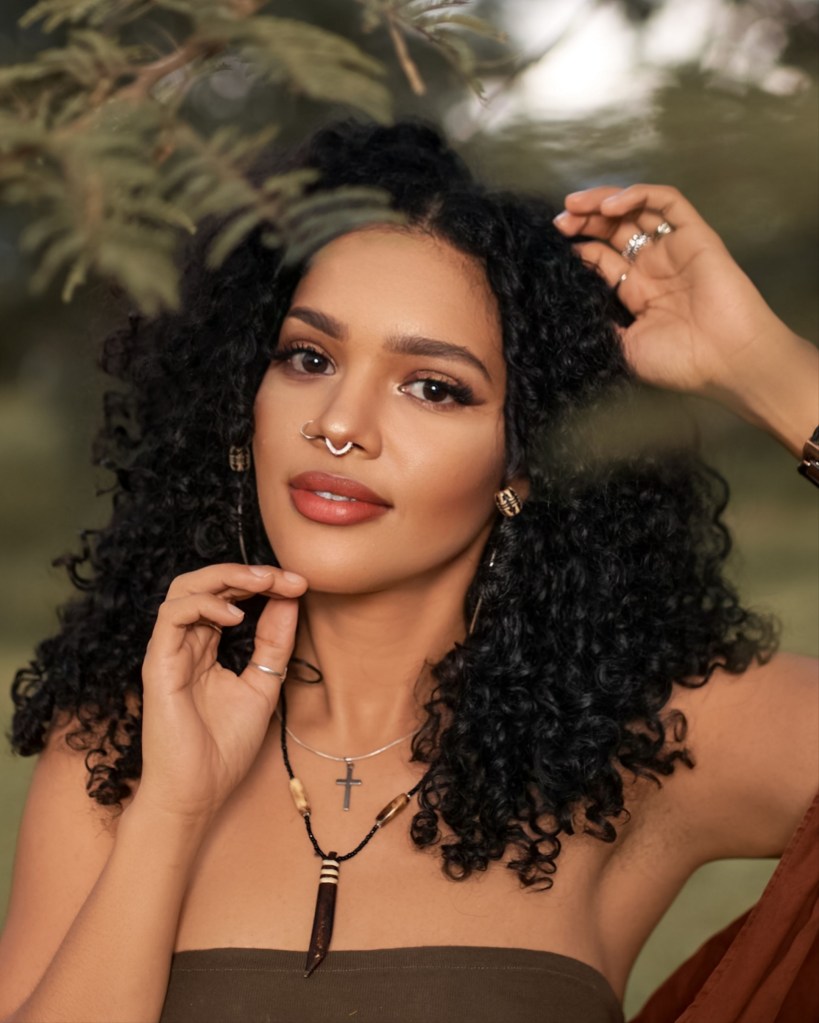
Eden calls this process, her music, “a service” — not a product, but something offered to the “people who need it.” In a media culture built on constant exposure, her work resists performance for its own sake, choosing instead a form of engagement that invites listeners into experience. Those listeners are often the ones who live most deeply inside themselves, drawn less to spectacle than to recognition. Their reward is introspection, tender, but never false. Eden’s music is parasocial intimacy at scale. It is shaped by labour that should not be made invisible or mistaken for charity.
That approach has not gone unnoticed. Her recognition has accumulated much like the room that nurtured her ambition: quietly, away from the cameras. Her music has reached radio audiences across the UK, Namibia, Zambia, South Africa and Zimbabwe. She has performed live in Italy and South Africa, shared stages with Carlo Music, Nutty-O, Nick Kuraz, Gemma Griffiths, Kelly Rusike, and appeared on Econet’s platform, Shoko festival, and Sessions Live. Still, music was never the whole story — it was only the loudest note.
Alongside her songwriting, Eden documents her creative process through YouTube vlogs, opening a window onto work that many artists only reveal once it is complete. She also animates, designs characters, and storyboards — a parallel practice that would surprise even those who have followed her since the early 2017/18 releases of Mercy Killing and Parachute. In fact, her work in this field earned her second- and third-place finishes in CGAfrica competitions, and later secured her a place in the Netflix and Triggerfish Animation Studios Creative Artist Lab as a storyboard artist. Her commercial clients have included the World Bank, Stanbic Bank, PPC, MedOrange Pharmacies, and TBWA\Worldwide. Taking into account all she has produced, we clearly need a wide-angle lens: there is clearly more happening in that room than any single static camera shot can capture.
In a generation convinced it has a right to know everything that happens behind closed doors, Eden seems to understand the distance between those two things. The scale of the private work. The public modesty of how it is presented. She carries that tension like someone who was once told to go to her room, and discovered that the room was the best thing that ever happened to her. That is where the work begins. The room is not a retreat. It is a generative engine for self expression.
TJ: So you learnt the guitar from your dad, and used his computer to make your music as well. It’s great to see that father-daughter synergy. What is the greatest thing you learnt from him?
EL: My dad is not only a musician, he’s a writer, he’s a poet, he is one of the most creative minds I think to have ever existed, and I think I owe a lot of my creativity to him. The greatest thing he taught me was the first four chords I’ve ever learned. I was 10, and from there I just taught myself, building on that foundation. Obviously he taught me more than that, but the first chords are like my first steps. I’m grateful that he introduced me to the guitar, because I love it so much. It’s a part of me.
AG: Wait a minute. You didn’t just use your dad’s computer to make music, you also made animated videos for your songs. We know about your first chords, but how did you get into animation?
EL: (laughs) Well, I got into animation pretty much the same time I started creating music. It was just so natural for me. I imagined visualisers and cartoons for my songs. But animation was very much a more formal path. I studied fine arts and design at Peter Birch School of Art, then I got involved in the animation industry after. I’ve actually worked with Triggerfish, Netflix and ALULA Animation. Then I did a couple of courses online through Animation Mentor. I also did a course with Disney and AFS. So I really progressed in animation. I think that’s why I’m such a good producer as well (laughs). I know how to produce VFX and animation. It made it a smoother transition to music. I can’t speak for everyone, but for me, it wasn’t hard to translate that knowledge of animation software to music production.
AG: Are there points where they overlap? Is there a skill from one — for example songwriting or video editing — that’s quietly improved the other?
EL: To be honest, at the moment I would have to say no. I haven’t been involved in the animation industry in over a year now. I’ve gone full-time into music production, songwriting, composing, and working with music tech companies like BandLab, Baby Audio, United Plugins, UV Instruments, and making content. I’ve even been testing AI vocal tools like Audimee. I guess the software component of sound and video is where there is overlap, now that I think of it. But I haven’t given up on animation. It will always have a special place in my heart, but I guess for now I’m sold out on music (laughs).
AG: You might not see it, but for me what all these creative roles have in common is that they are all made in one room — or creative space. There’s a version of you that exists in animated videos, songs, vlogs. And a version that exists once the work leaves that space. How different are those two people?
EL: Yes! There’s definitely two versions of me. There’s the introverted artist that just loves the production process of creating. You know, I used to hate crowds and festivals, and sometimes I feel so awkward and shy performing. Then there’s the rockstar inside of me! When she’s on stage she has so much confidence. I definitely have been more of the introverted nerd in my life, but recently I think turning 30 just brought me out of my shell. I found all this confidence, and I find I just love to be more on stage and rocking out now.
AG: I really do enjoy that “music nerd” side of you. It’s on full display in your YouTube tutorials. The BTS one really revealed those visual-to-music production skills. But what stands out for me is that you’re a natural storyteller.
EL: (laughs) Well, thank you for watching my behind-the-scenes channel! Yeah, I just love sharing my creative process and I’m blessed that I’ve gotten so many sponsors for my content. I am a storyteller and I just think I’m blessed that I get to do it every day. Well, when I make the time to do them.

TJ: Your music has always been quite personal — emotionally raw, diaristic, very much in that Taylor Swift, Olivia Rodrigo, Lorde, Hozier tradition. People often dissect those artists’ lyrics to identify personal information. Does your shy side ever worry about oversharing in your art?
EL: Yeah, you know, my music has always been so honest and it’s gotten me into trouble. Some people have gotten upset over a couple of my songs. But I never want to be inauthentic. I’ve experienced not so much judgement online, but a lot of rejection from church. Even though I’m a Christian, I feel like a lot of my fellow churchgoers don’t understand why I write the way I do and why not something that sounds like Elevation Worship. There’s nothing wrong with that kind of music, but I just can’t force myself to be inauthentic — I write from my heart. I turned to music as a way to process my emotions and to tell a story, and it was never about being famous, or showing people how righteous I am. It was never about just making earworms for the radio, it was always to express something that I couldn’t put into words. I’m not afraid of oversharing, that’s how I feel. When I do share my true feelings, I feel goosebumps (laughs) — I think that’s God.
AG: You have such a dramatic imagination. I’m surprised that you once worried people might not get “Maiwee” because mixing indie rock with traditional sound felt like a “Frankenstein” experiment. Sylent Nqo’s “Sewe” follows a pretty similar tradition. What initially brought those two genres together for you?
EL: (laughs) So funny story about “Maiwee” — it actually got a tonne of hate at first! Even myself, I grew to hate it. People made fun of my accent and my Shona singing (laughs). I don’t know, I never really spoke Shona growing up, but I got so much pressure from managers and producers, so I forced myself to sing in Shona. On the other side, I really just love indie-rock and alternative music. That’s all I want to make. I’ve never tried to fit in. But that pressure from people caused me to mix it in. So I thought, well, let me give it a try and mix the two worlds — Shona music and indie-rock. I think the reactions from people and the tension it caused just made me want to set the video to private for a while and just disappear (laughs). People had never heard an indie-rock song mixed with Zimbabwean traditional music in that way, and I felt embarrassed about it (laughs). So I kind of looked at it like a Frankenstein, really experimenting. I didn’t know if it would stay alive or I’d have to shut it down. Sometimes you can create something that you’re afraid of. I didn’t realise at the time that just because no one else was doing it doesn’t mean it was bad — it just means I was doing something new. Then two years later Sylent Nqo releases “Sewe” and I’m getting a lot of messages from people saying “wow, this sounds like your song.” So I’m glad that “Maiwee” and “Sewe” are chartering a new path for Zim artists to follow, that probably didn’t exist before in that way. Mostly I’m just glad that it’s a sound that’s recognised now, because I had got so much resistance for expressing myself and being unique — I guess it paid off.
TJ: You’ve worked with Zim producers like Verseless as well as Jesper Hassleberg, who is based in Sweden. You are a sound blender (laughs). What does a Zimbabwean sound mean to you?
EL: Picture when you’re not at home, when you travel. You can hear an Alec Macheso song and you can instantly feel at home! To me the Zimbabwean sound is something you can’t find anywhere else. Maybe it’s our lingo, our instruments — the mbira, guitar solo, hosho, and marimba — it’s our vibe. I’m definitely always looking for ways to implement more of my culture and heritage into my music now. I’m even writing lyrics in Ndebele these days. My mom is half Ndebele and she taught me a few phrases. I also wrote a song with slang from our mixed-race community. I just think my next project is going to be so unique and spiced up with my heritage — I can’t wait for people to hear it! I definitely got a lot to say.
AG: Are you gonna add some animation? I know you stepped away, but you’ve been around Netflix, Disney and Pixar people. Is there a project you’ve been building secretly?
EL: Yeah, I’m always secretly working on projects. I have projects that I think “you know, I could put this out and people will love this,” and I also have projects that are just for me. But they’re mostly, probably, songs that will never be heard by another human being. I’m always writing though, and sometimes the songs scare me because they are so raw and honest. I think every artist has a secret stash of work or random ideas they scribbled down somewhere. You have to, if you are a true creative.
TJ: Lastly, you’ve said some of your songs come from conversations, dreams, and showers — moments in the subconscious you didn’t go looking for. Has a song or lyric ever arrived and told you something about yourself you weren’t ready to know yet?
EL: (laughs) Definitely. “Maiwee” is one of those songs — it came to me while I was driving. The line “I should, I could, I woulda, I should have treated you better, Maiwee” — that’s the first line that came to me and I just got goosebumps immediately. Like I knew it was something special. I went home and produced the demo in 30 minutes, and posted a TikTok singing the song. It went viral and the rest is history — it did so much for my career and I’m so grateful that I wrote that song, despite all the anxiety and pressure it gave me (laughs).
There is a particular kind of creative economy emerging across the world right now. It is built by people who learned to be both the creative and the broadcaster because the infrastructure does not always encourage specialisation. It does not depend on any one gatekeeper saying yes, and it is more interested in viral moments than in durability. Eden is one of the clearest examples of how to navigate that terrain. Her work is self-made, multidisciplinary, and already validated by people’s own ears before any formal label fully organised itself around it. The industry has had to catch up to her. Doing the work herself was never a deficit. It was the training ground — the place where she built the skillset first, and let the path appear after. That is the model the future is already favouring.
Follow Eden @edenangmusic

