How streetwear turned from rebellion to bespoke custom wear.
Words by Bradley “Word Pill” Moyo (Writer/Poet)
Questions by Alex Gwaze (Curator), Terry-Jo Thorne (Researcher) and Bradley Moyo
Zimstars Award nominee Richard Ndumiso Moyo didn’t walk into fashion through the front door. He cut his way in. When his sister’s discarded bum shorts needed a second life, he transformed them into a college bag and carried it to Lupane State University, where he is studying Tourism and Hospitality. That gesture — born of necessity, executed with instinct akin to Harlem legend Dapper Dan — became the founding philosophy of Richard Jeans: upcycling, experimentation, resourcefulness.
Zimbabwe’s decades of economic constraint had long made circular design a survival language. Richard simply made it a signature, long before “sustainability” became fashion’s most overused word. To understand how he did it, you have to understand where streetwear has been. Streetwear was born as subcultural defiance in the late 1970s and 1980s, driven by young tastemakers in New York, Los Angeles, and Tokyo — prizing comfort and raw self-expression over stiff dress codes, rejecting mainstream norms. Hip-hop culture later amplified the vision — brands like FUBU, Tommy Hilfiger, and Evisu plastered across music videos — fused with the bespoke flair of Harlem’s Dapper Dan and his logo-heavy edge. Virgil Abloh later sealed the pact, blending Off-White and Louis Vuitton menswear to marry street grit with luxury polish. Today, streetwear graces runways in Paris, Milan, and New York, co-opted by titans like Louis Vuitton, Prada, and Gucci. And brands like Fear of God, Amiri, and Aimé Leon Dore rival Dior.
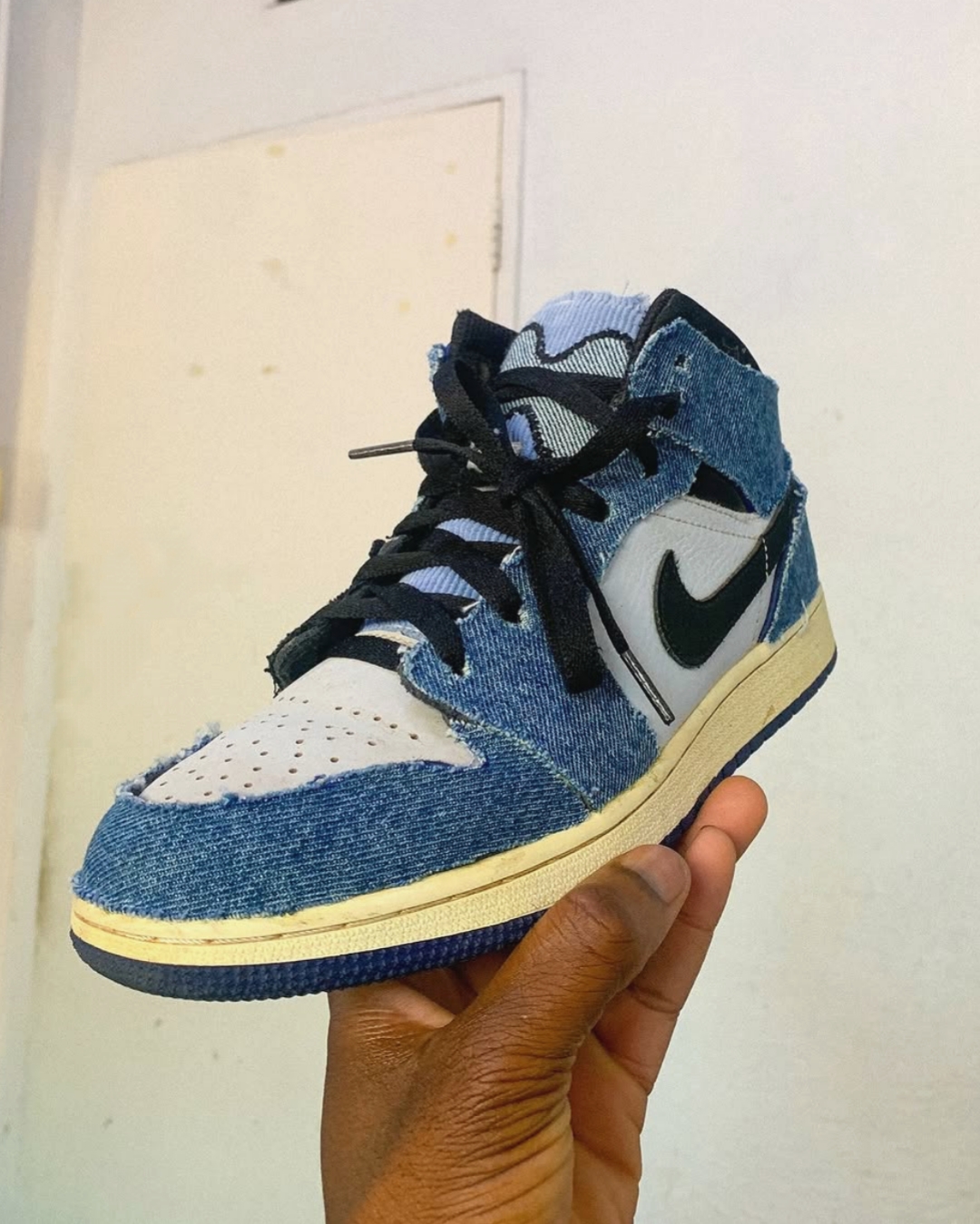
It is into this lineage that the Bulawayo-born designer plants his flag. Richard quickly moved from improvisation to institution — leveraging strategic proximity and creative disruption, à la Abloh, bypassing fashion conservatories through high-profile collaborations: styling Holy Ten’s “Can’t Get” video, engineering musician Asaph Afrika’s iconic “Mhofu” denim sling bag, and customising J1 sneakers with Xandieee. All the while maintaining his grassroots presence with stalls selling one-of-a-kind custom pieces at high-profile fashion events like the Fabric Party, Sneaker Expo, and Thrift & Threads BYO Edition — merch drops that carry the same energy as Supreme or A-COLD-WALL releases.
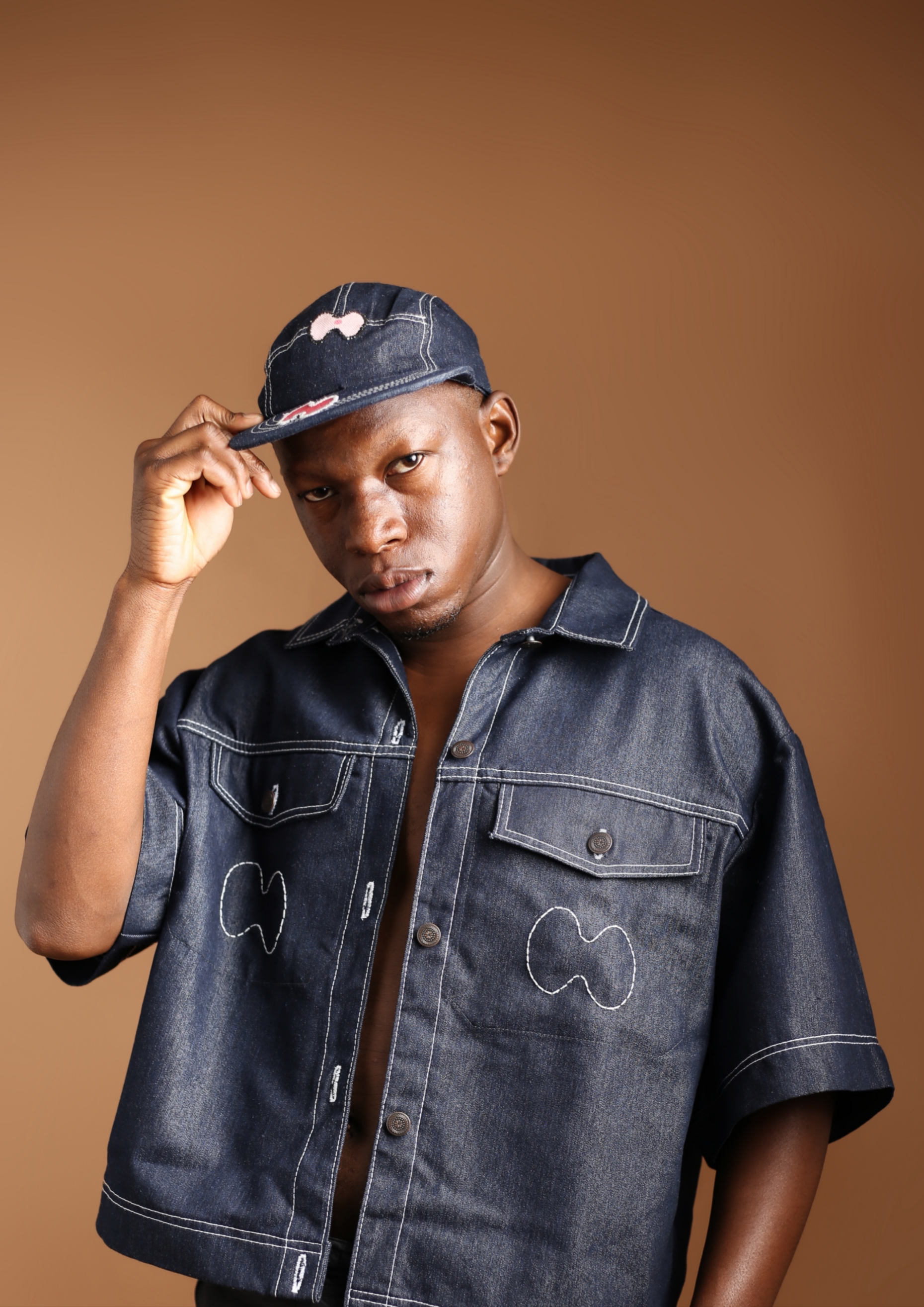
In the current moment — where “jorts,” wave caps, oversized silhouettes, and baggy proportions have been elevated to high-art lexicon — the way Richard is moving is both retail and culturally intelligent. Kanye West engineered this bridge between street credibility and institutional fashion, proving that cultural authority could force luxury houses to negotiate on street terms. Richard inherits that logic and extends it: where Kanye leveraged spectacle, Richard leverages craft. Customisation and sustainability aren’t add-ons to his practice — they are the practice. Contemporary streetwear consumers demand more than the aesthetic of the superstar look — they require material ethics: sustainability, durability, production integrity. Richard doesn’t just occupy this space. He was shaped by it, serving locals before the industry had a name for it.
For them, Richard represents a generation of African creatives rewriting fashion’s rules — not by seeking entry into existing institutions, but by building parallel ones, rooted in local knowledge, constrained resources, and an intimacy with their communities that no design school curriculum can manufacture.
AG: The first thing that you made was a denim bag to carry your books — not a backpack. Very unconventional. Has moving differently always mattered to you?
RJ: I’ve always been big on being different — it’s one of the reasons why the brand even exists. And the fact that you paired it up with one of the first pieces that I ever made is (laughs) actually genius. The first thing that I made was a denim tote bag — actually made from a bum short. (laughs) This happened before the brand was even born, before I even knew how to use a sewing machine. I feel like for every creation, there always has to be a problem that is being solved. My problem was that I hated carrying books to school because I didn’t like backpacks. It was just too normal for me, too plain, not special — I wanted something crazy, something different. It took me quite a long time making the bag because I was hand-stitching, freestyling — I didn’t know patterns. (laughs) But because I’m such a perfectionist, I had to take it to a tailor in town, someone who could sew over my stitches with a machine. They did a fairly good job, but it wasn’t up to the standard that I would have wanted it. I had to learn to use a sewing machine. But from the first day that I rocked the bag, I realised I could live my everyday life as a different person.
AG: Denim is a sturdy, “hardworking” wardrobe staple — it’s everywhere, and taken for granted, like sadza. For someone building something meant to feel “cool” and “new,” why go back to something so common?
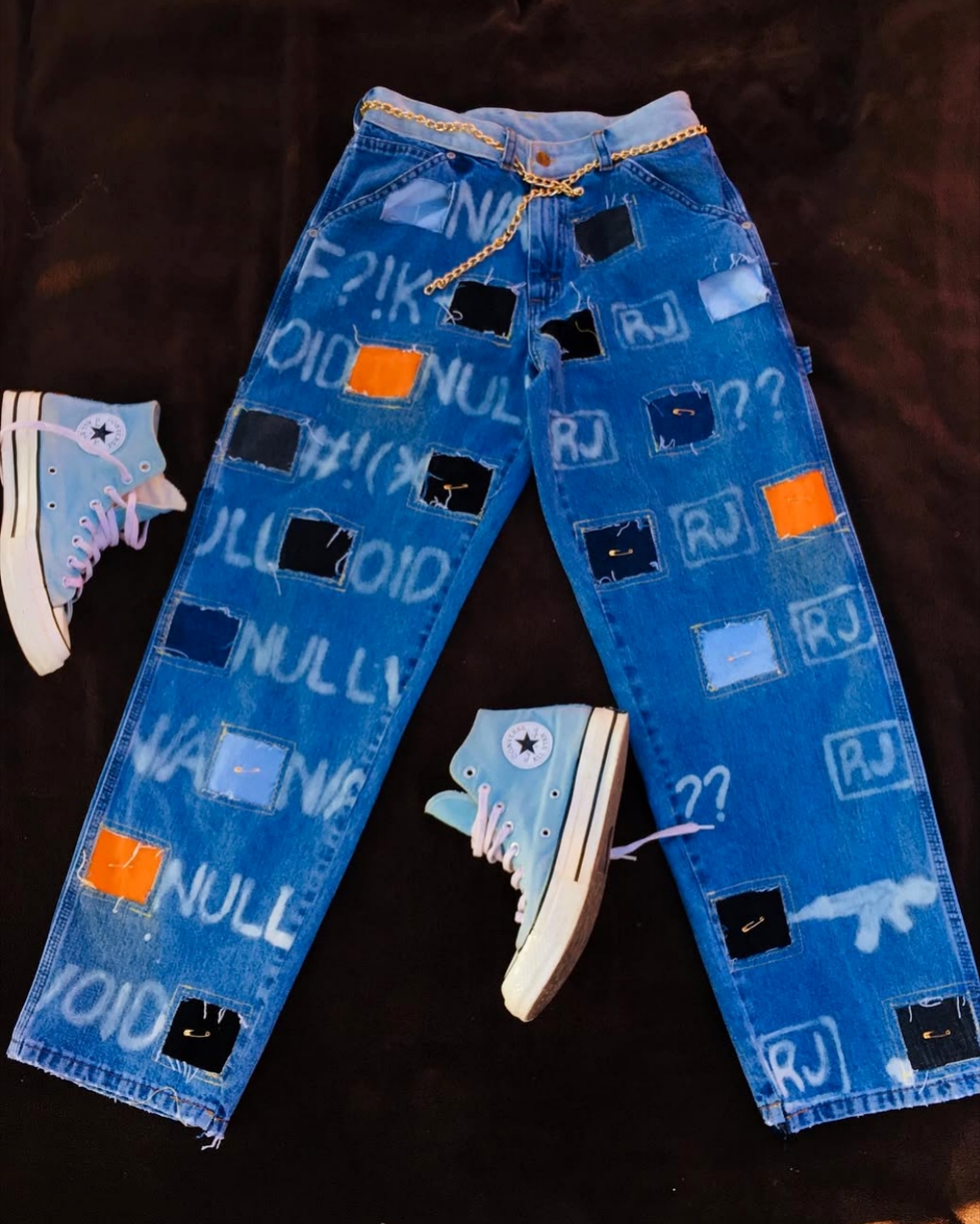
RJ: I did not choose denim intentionally to say I’m going to use jeans for my brand. I just loved quality, and also I’m a big thrifter. (laughs) I sort of hate shopping at the mall, because at the mall you’ll find something new, but the quality might be wack. But when you go to the thrift, you find something maybe that’s slightly worn but the quality is very good. I’ve also been someone who likes to work with what they have. I didn’t have money to go and buy fabric because it’s quite expensive, even in Bulawayo. So for me, the brand became Richard Jeans because jeans were something that I could easily find myself and upcycle. I didn’t want to have an excuse of saying, “I don’t have money to buy proper fabric, so I’m not going (laughs) to do anything. I’m just going to sit and wait for the right time.” So I was like, “Let me just use what is at my disposal to start, to build on the ideas that I had, and to make the vision that I wanted come alive.”
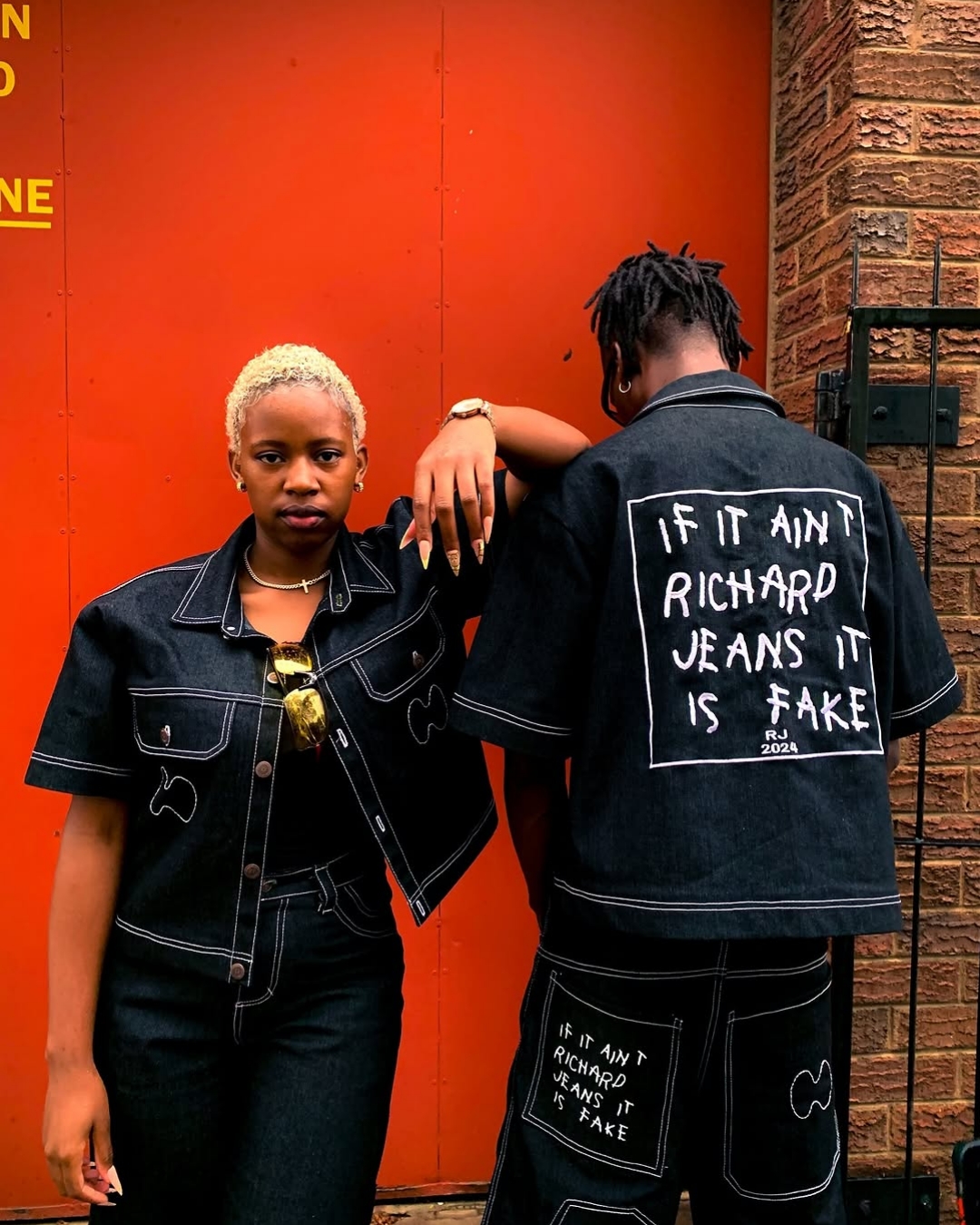
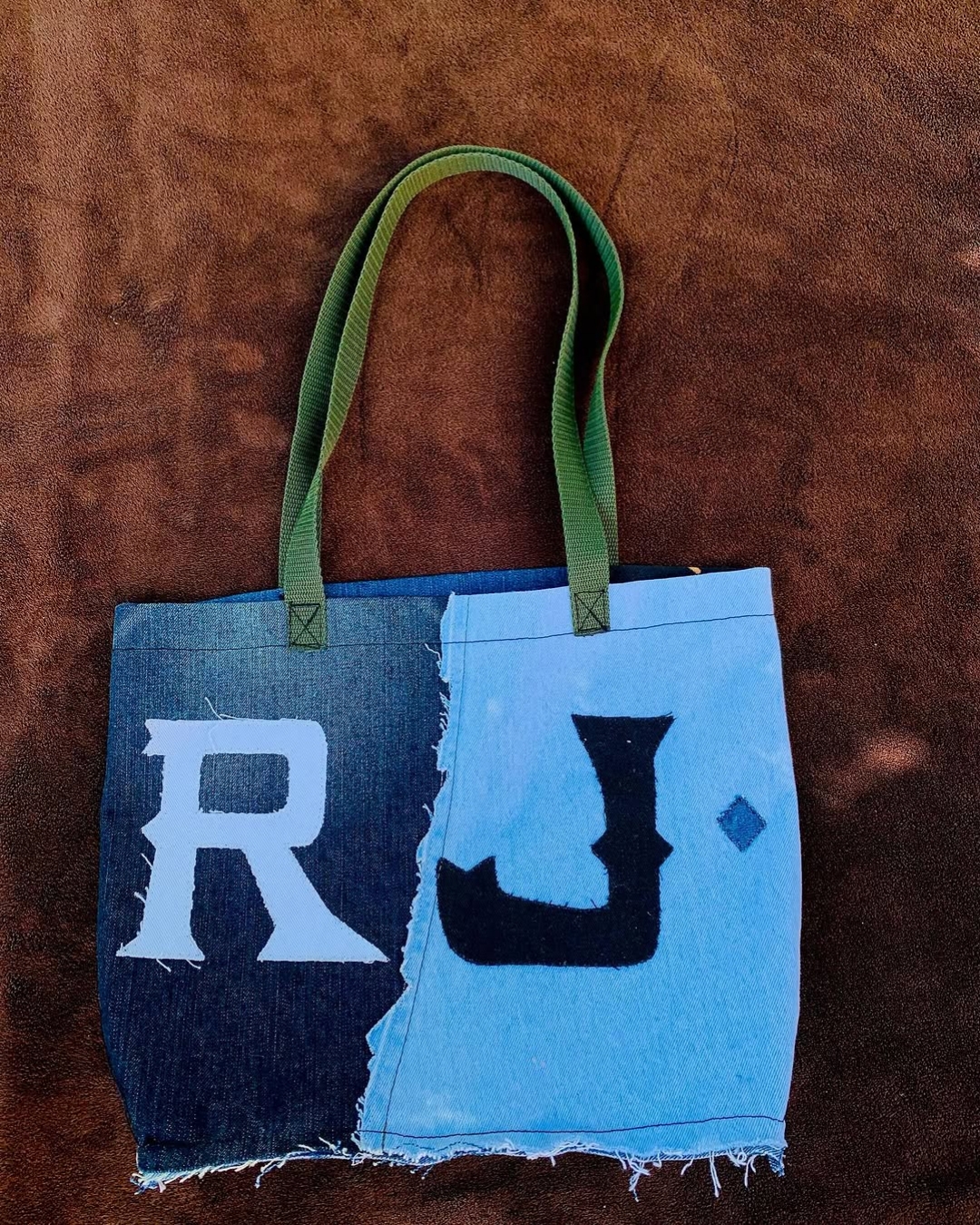
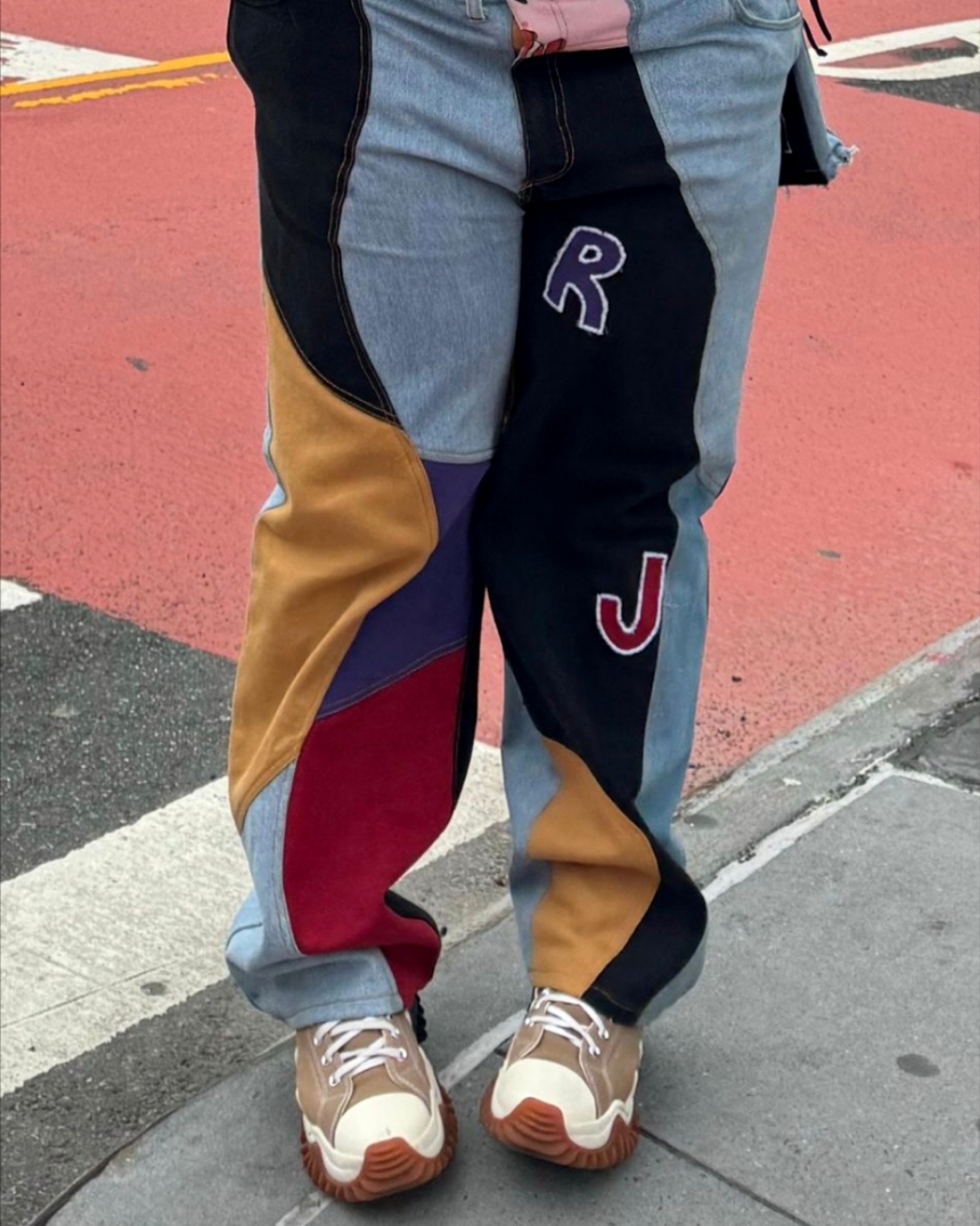

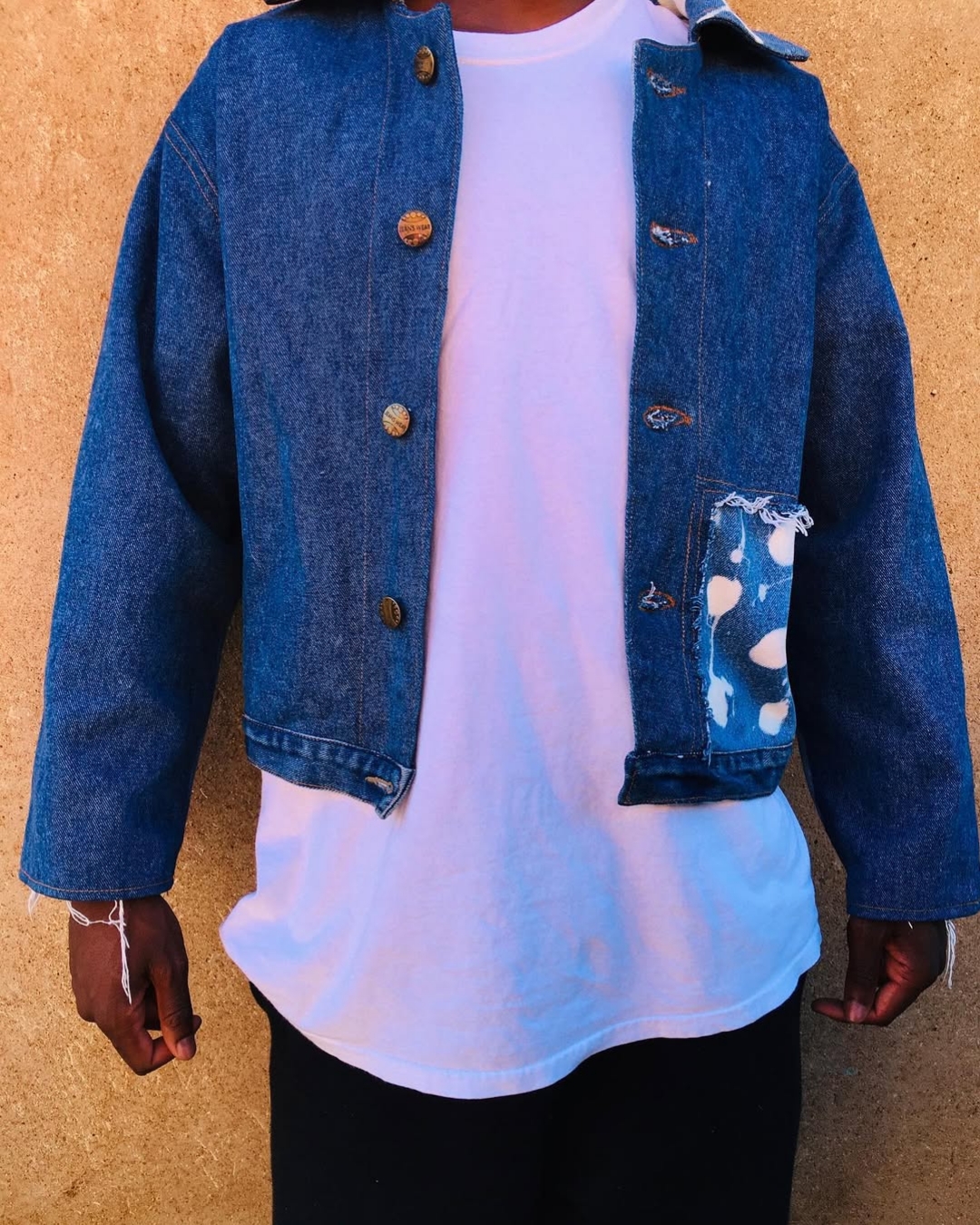
BM: Your brand is built around turning old denim into one-of-a-kind streetwear. In a world of fast fashion and textile waste, do you see your upcycling as responding to that reality?
RJ: I have to be honest, when I started I was not so aware of fast fashion and all the sustainability issues around fashion. I was just making what I was making, not responding to that reality. But over the years, as you grow, you learn about things, and I realised that I was solving a problem that I didn’t know existed. When you create something, it might not necessarily just solve the problems that you see — it may solve even other problems that you do not. I do believe that upcycling is an amazing response to the reality of fast fashion and textile waste, because we’re now in a very dangerous stage when it comes to resources depleting, environmental issues, energy issues. Upcycling is not the complete solution, but it is a step towards future solutions that we are likely going to need. What we do in the fashion industry tends to influence other industries, because fashion sets trends. (laughs)
TJ: That trend has to come from the big legacy brands first. As a streetwear designer, which is often viewed as casual, you’re pushing it towards custom, almost haute couture luxury brand spaces but for individual clients — where do you see your work sitting in that landscape?
RJ: Streetwear is very flexible. You can make it into whatever you want — haute couture, cheap, quick and affordable for everyone. But it depends on how you style it, how you introduce it to the market, how the clothes are produced. I did not really try to classify myself into any of those hierarchies. I’ve treated myself as an artist. I do not want to put myself in a box and limit my ideas. I just wanted to create and create. I pride myself in making sure that whatever piece I make, I put my heart and soul into it so much that sometimes I’m like, “Ah, no.” Maybe the client thinks it’s too much, or it doesn’t go with their style. (laughs) But I would happily rock it. Almost everything that I make, I would happily wear myself if the client were to say, “Ah, no, I cannot wear this. Can you make me something else?” And it has happened a couple of times. I end up selling that particular piece for even more than the amount charged for the first client who declined it, because it’s a complete product I can market separately — no longer a private commission. Even when I go outside the house I make sure that every day that I’m wearing something from Richard Jeans. I am from the township — I will always have pieces that people from the hood can afford, can also buy. We’re just trying to create a community not scared to be different, or who are proud to express themselves, who want to look like a superstar.
BM: You’re designing from the hood in Bulawayo — not Paris, not Milan, not New York, the cities that traditionally dictate taste. How does that distance shape what you make?
RJ: I believe the next big thing can come from literally anywhere: Kenya, Zambia, Zimbabwe, anywhere. And for me, that distance has not been of any effect to my brand, because if you are honest with yourself and honest with your art, whatever you create is beautiful. I’ve just been creating beautiful art without any borders in mind. Creating things that can be worn in Paris, things that can be worn in Luveve, Hawaii — literally anywhere. In fact, a lot of my clients are diaspora — places like Chicago, New York, South Africa, even Germany. And yes, they know it’s from Bulawayo, and that is a good thing for me, because it’s different, unique, not local to them. They won’t be feeling like they are wearing a small brand from a small town.
TJ: You know, in those fashion capitals — brands like Balenciaga — are leaning into streetwear on the runway. From where you stand, why is streetwear being absorbed into luxury brands?
RJ: Streetwear is just where it’s at. That’s where all the culture, all the trends — everything is built in the streets. You can even see it when you look at how Virgil actually took the creative direction at Louis Vuitton — turning a luxury brand into something that the kids in the streets want to mess with. And I believe that collaborations between luxury brands and streetwear brands tend to make people even more excited for those brands, because the normal people don’t have access to buy luxury brands — they’re expensive. But collaborating with streetwear brands gives them an entry level in, because streetwear brands are somehow cheaper, most of them.
AG: We’ve even seen Kendrick Lamar stepping out at the Grammys in a full Canadian tuxedo. In a Zimbabwean context, do you think streetwear can hold space at high-profile or formal events?
RJ: Streetwear has the potential to hold space at elite events, even here in Zimbabwe. It’s just a matter of getting the right designer and the right concept for whatever event you are attending. But the problem is that most artists do not value streetwear brands as much as boutique brands — brands that make suits, dresses and formal items. So when they do approach streetwear designers, they always come with a low budget to make a proper outfit for a red carpet event. They do not value the effort or the creativity. Some don’t even pay — they want to pay with exposure or something like that. (laughs)
TJ: What’s the most unexpected or demanding piece you have ever made?
RJ: There’s always times like that for almost every piece that I make — just questioning everything. But there’s this patchwork dungaree that I made for this other girl called Anisu, who is in the States. It was quite a crazy one. My first time making a dungaree, and a patchwork one for that matter, with multiple colours! That may have been one of the craziest pieces. But there’s also a shoe rack that I made — yeah, a denim shoe rack. Furniture made in denim! It was a bit challenging making it, but it actually came alive at the end. (laughs)
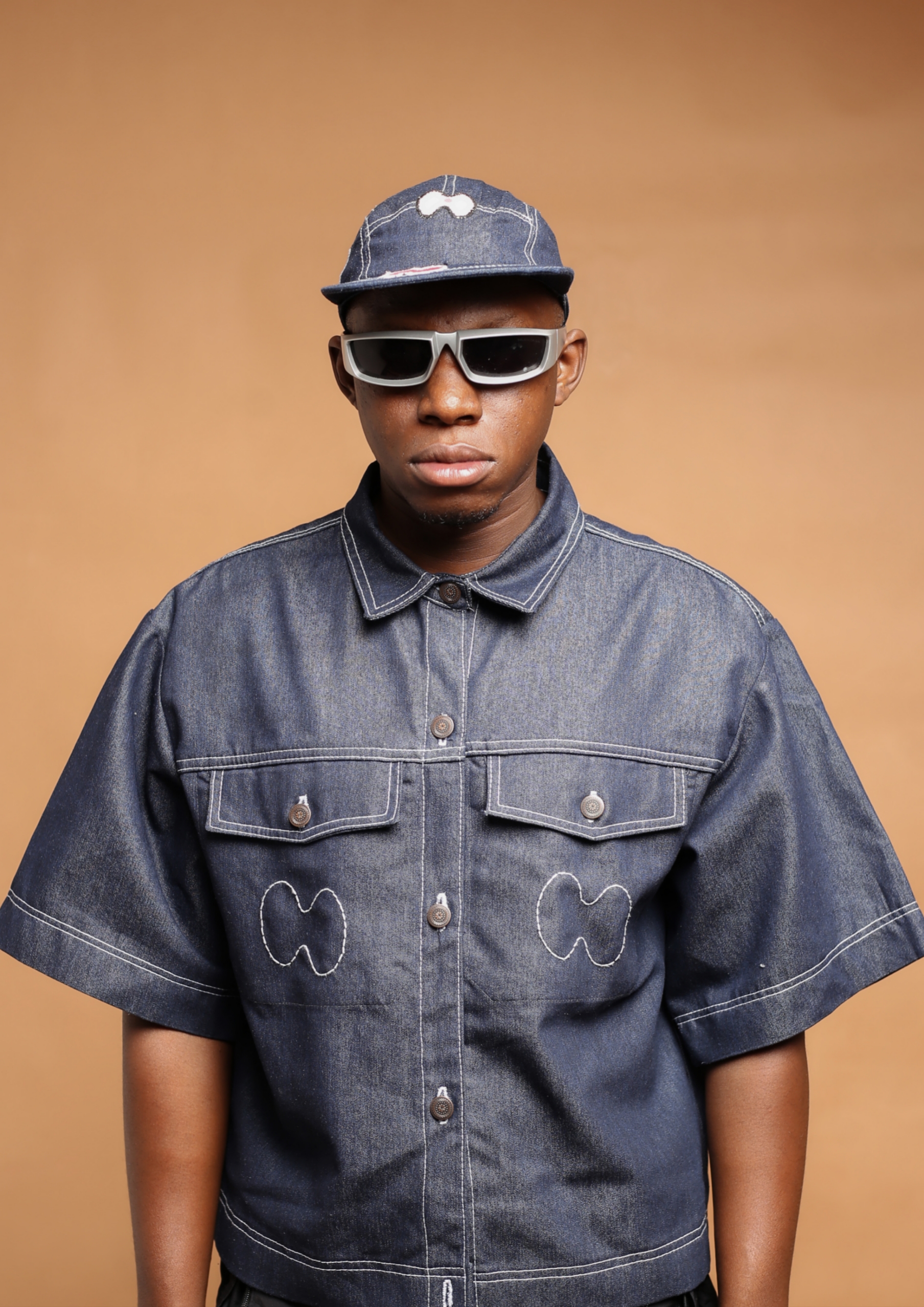
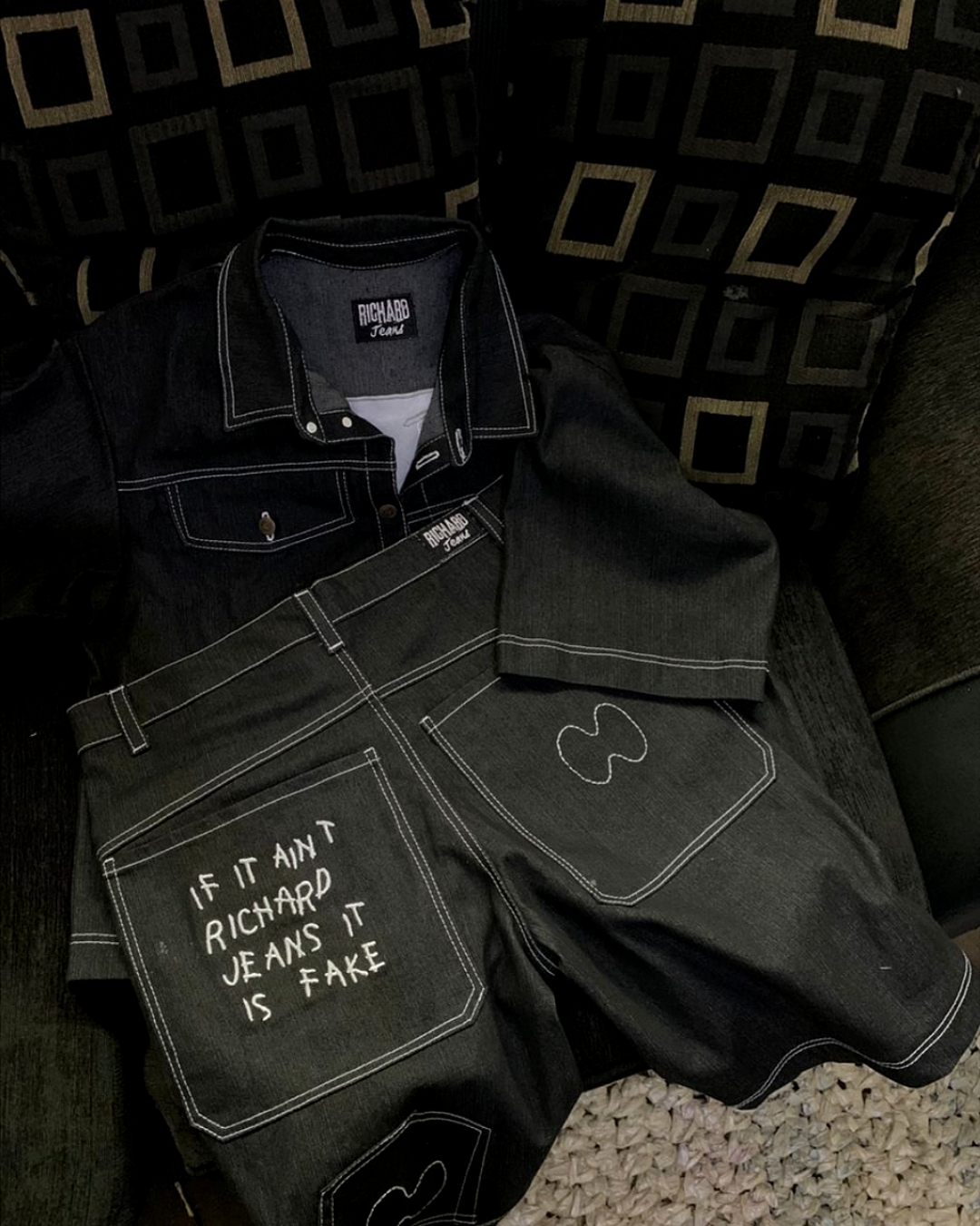
BM: I’ve seen some of your garments written: “If it doesn’t say Richard, it’s fake” or “On the go.” Are these declarations? Warnings? A marketing strategy?
RJ: (laughs) I did not expect that question, but it is a really good question. So — “If it ain’t Richard Jeans, it is fake.” Okay, so what happened: I released bags in 2022 that were written “RHA 22” underneath. My friend was telling me that there were copies of my designs all over the streets. This was around the time when I was popping up, still coming up, and we were just joking around — just a little bit like, “Ah, man, if it ain’t Richard Jeans, it is fake.” And that’s just how (laughs) the thing came alive. When I got home, I painted a square in white on the bag and just kept thinking of what to write. At the time I was listening to Drake’s album If You’re Reading This It’s Too Late. And then the idea just came to me — “If it ain’t Richard Jeans, it is fake.” The reaction I got from people when I rocked that bag for the first time was even way more amplified than what I was getting from the first bag. I remember this other girl literally tripped trying to read what was on the bag. (laughs) I was coming off the taxi, and yeah — I went back home and did a whole collection. (laughs)
AG: (laughs) You are great at recognising and building on your momentum. Lastly — right now you are positioned as the “Denim Don.” Do you see yourself deepening that identity, becoming something like Levi’s, or eventually moving beyond it — into something completely different, like lingerie?
RJ: (laughs) The Denim Don part, I guess, just comes with the fact that most of my designs have always been in denim. I’ve used denim as a medium, but I’m not trying to lean into denim and deepen it. I want to keep my creative ideas in an open container, so I can easily execute them. So I am actually rebranding (laughs) — but not veering too much from my core values of customisation, self-expression, individuality, community. I’m rebranding to a new name that will allow me to explore more mediums and more of my own family heritage. I’ve come to realise that I come from a creative family — my grandmother, my uncle, there are so many people who have done creative things before me in my family. So I want to explore even that part of my family heritage and incorporate it into my designs. So maybe it’s not rebranding but expanding — creating a new branch from the main Richard Jeans brand that can grow separately. Anyway, thank you so much for this interview. Shout out to Home Run Channel. Shout out to Bradley. Shout out to everyone at MUD. Appreciate you all so much.
When fashion’s sustainability discourse risks becoming mere optics, Richard Moyo practises circular design as philosophy. He constructs wearable art from quality discards — durable by birth, destined for new wardrobes rather than waste streams. His bespoke pieces aren’t mere experiments; they argue a position: that individuality and function are not competing values but the same instinct, expressed through different hands. Denim, in his practice, ceases to be static material — it becomes a medium, reworked and reshaped until it carries the personality of its wearer and the resilience of the streets it was made for. Streetwear’s global authority was never an accident. It was utility, methodically refined. Richard Jeans is proof that this truth holds as firmly in Bulawayo as it does in Brooklyn.
Follow Richard @richardxjeans


One thought on “Superstar Streetwear: Richard Jeans Q&A”