How a borrowed instrument became a career, a philosophy, and cultural infrastructure.
Words by Alex Gwaze (Curator)
Questions by Alex Gwaze & Terry-Jo Thorne (Researcher)
The guitar is the most communal instrument alive. It does not ask for a concert hall or a producer behind glass. It travels in the back of a bus, rests against the wall of a church, and turns a stranger’s living room into a confessional. In the right hands, it becomes something more than music. It becomes a conversation the whole room is having at once.
In Zimbabwe, that conversation has long carried weight far beyond melody. From Thomas Mapfumo’s Chimurenga sound (that unmistakable weave of mbira patterns into rock protest) to Oliver Mtukudzi’s deep vernacular Tuku feel —guitar-driven music here has historically functioned as social mirror, as eulogy, as manifesto. Tuku gave Zimbabwean music something rare: a voice simultaneously intimate and monumental, rooted in Shona yet expansive enough to carry grief, tenderness, and unspoken truths into the global arena. The modern Afro-jazz sound, as the world came to know it, was in no small measure partly his. That said, it is from this lineage — and with a distinctly feminine, interior register — that Tariro Chaniwa emerged.
She performs under the name Tariro neGitare, a Shona phrase that translates, simply and perfectly, as “Hope and the guitar.” There is something worth sitting with in that name. In Shona, the word “ne” — meaning “and” — is a connector, not a possessive. It places artist and instrument in genuine companionship, side by side, equal. As if they arrived together, made an arrangement, and have been keeping it ever since. This is not an artist who plays an instrument. This is a partnership. The instrument has a say.
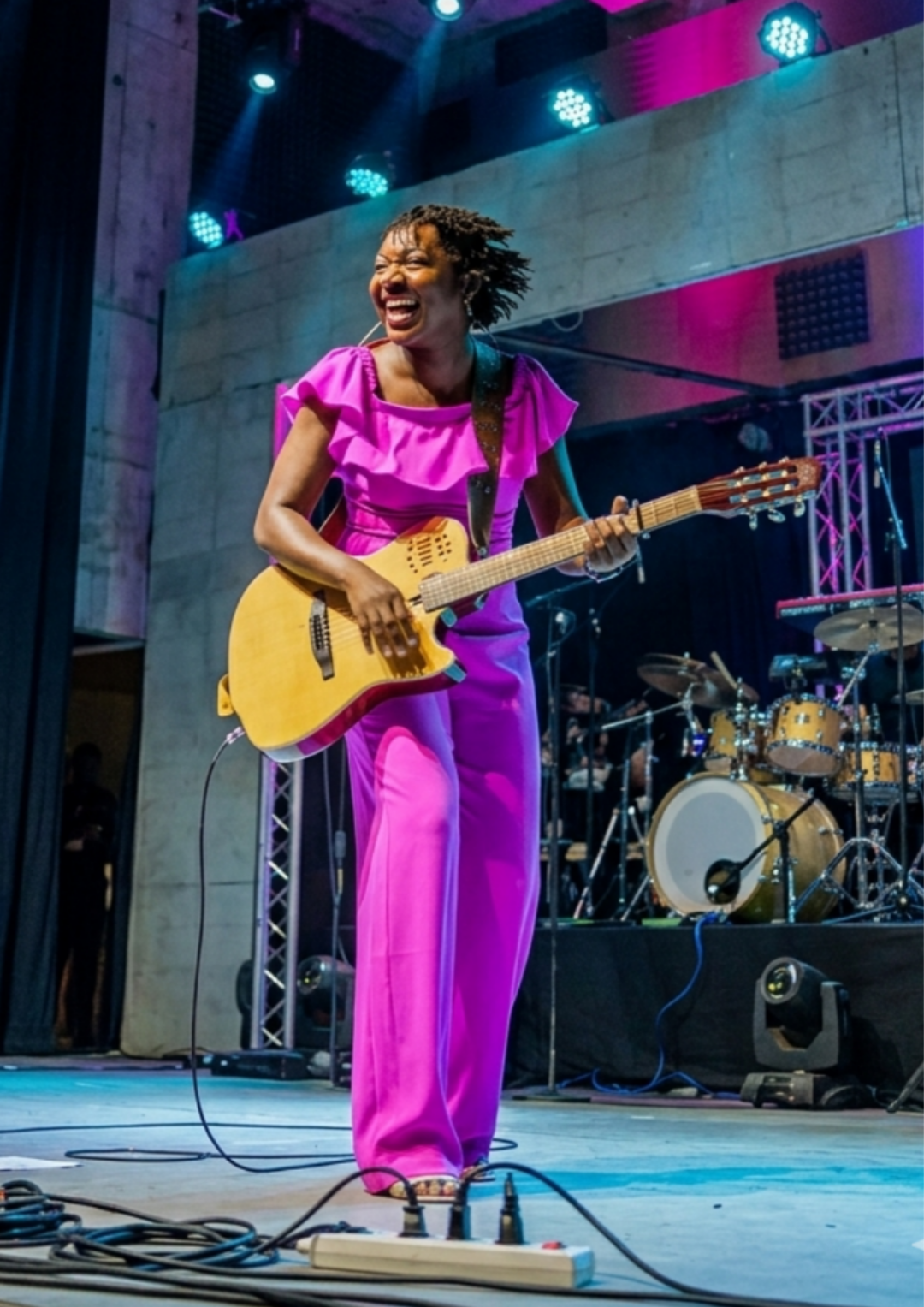
That partnership began somewhere unexpected. Tariro first learned to play not from a mentor on the Harare music circuit but from a German nun — Sister Elizabeth Wedeking — who placed a guitar in her hands and set something in motion neither could have fully anticipated. The borrowed instrument migrated from classroom to church to stage, finding its purpose gradually, the way a friendship deepens: through repeated contact, through time. She sharpened her craft at the Sistaz open mic at the old Book Café — the legendary gathering space that functioned for a generation of Zimbabwean artists as rehearsal room, creative salon, and communal hearth. It was there that Tariro began building not just a set list, but a listenership.
Her performances, anchored to voice and acoustic guitar, stood out for what they did not do. There was no elaborate production, no wall of sound to hide behind. What remained was something harder to manufacture: emotional clarity. Rooted in blues and folk tradition, warmed by Afro-jazz and Afro-soul, and tethered always to Zimbabwean heritage, her music carried themes — resilience, faith, the everyday weight of modern womanhood — so precisely observed that audiences heard their own lives in them. There is something disarming about an artist alone with a guitar. There is nowhere to hide. Tariro made that nakedness her art form.
The industry followed. Multiple nominations at the National Arts Merit Awards (NAMA), the Zimbabwe Music Awards (ZIMA), and the Zimbabwe International Women’s Awards (ZIWA). A OneBeat Fellowship from the U.S. Embassy. A Pop-Up Call award from the Zimbabwe German Society and Goethe-Zentrum. Tours across Africa and Europe, where she shared stages with Bryan Adams, James Blunt, and Ladysmith Black Mambazo — and with the late architects of her own tradition: Oliver Mtukudzi, Stella Chiweshe, Zahara, and Chiwoniso Maraire.
While Tariro’s early career was built on intimate performances, her influence has grown far beyond the stage. She armed herself with a BSc in Sociology and Gender Studies andMaster of Science in Developmen from the Women’s University in Africa. Then she began asking what the local creative ecosystem needed. The answer took shape through her initiatives that include: Magitare Africa Trust, Wildfire Acoustic Night, Khuluma Culture, the creative economy radio show Business Unusual on ZiFM Stereo. This all culminated with her managerial role at the Stanbic Jacaranda Music Festival — now one of Southern Africa’s largest music gatherings.
What Tariro represents is something a growing number of observers are beginning to label: the artist-organiser. A creative professional who contributes not only to artistic output but to the systems that sustain it. Across a continent where institutional arts support can be unreliable, Tariro represents a different model — proof that African artists need not remain only talent. They can build the room. They can become the architect of a sustainable creative community.
AG: Since the 1950s, the guitar — particularly the electric guitar — has been viewed as a predominantly male, “Americana” instrument associated with rebellious energy. Yet you were taught to play by a German nun. That is the polar opposite of the “rockstar.”
TG: You know, it’s hilarious when you put it that way. Most people imagine a garage or a basement, but my “rock and roll” started in a quiet, disciplined space with Sister Elizabeth Wedeking. Honestly, it was the perfect foundation. While the world saw the electric guitar as this tool for rebellion, she taught me the guitar as a tool for service and storytelling. There was no ego in her teaching. It wasn’t about being a “guitar god”; it was about the discipline of the craft. That “polar opposite” vibe actually gave me a very grounded relationship with the instrument. I didn’t pick it up to be famous; I picked it up to express something’s heart.
AG: When I think of female guitar icons, Tracy Chapman, Odetta, Joni Mitchell, and Joan Armatrading come to mind. Who are your “guitar heroes” — regardless of gender?
TG: Oh, you named some giants! Tracy and Joan are definitely in the DNA of what I do. But if I’m looking at my personal heroes, I have to start with Oliver Mtukudzi. His rhythm guitar playing was a masterclass in “less is more.” It wasn’t about flashy solos; it was about that “Tuku Music” pulse. I also look up to India.Arie for how she marries the acoustic vibe with soulful messaging. And then there’s Earl Klugh — the way he makes a nylon-string guitar sing is just pure magic. For me, a hero is anyone who makes the guitar feel like an extension of their own voice rather than just a piece of wood. And we can’t leave out Lauryn Hill, who literally shaped me as a musician.
TJ: You’ve shared the stage with Oliver Mtukudzi and Stella Chiweshe. They cemented the fusion of guitars, mbira, and hosho as a distinctly Zimbabwean sound. As a practitioner in that tradition, what do you think gives this specific sonic combination such a powerful global appeal?
TG: There’s something spiritual about the fusion of the guitar with the mbira and hosho. I think the global appeal comes from the “earthiness” of it. The mbira has this ancient, celestial frequency, and when you translate those patterns onto a guitar, it creates a polyrhythmic trance that people feel in their bones, even if they don’t understand the Shona lyrics. It’s a sound that feels like “home”, no matter where in the world you are. It’s organic, it’s rhythmic, and it’s deeply communal.
AG: I remember you performing with a beautiful Santa Fe guitar; it had this very curvy, almost feminine silhouette that seemed to mirror your brand and vocal texture. Did you choose that specific model consciously to fit your “image”, or was it purely about the “sound”?
TG: Ah, the Santa Fe! You have a good eye. To be honest, it was a bit of both. At first, I was drawn to the technical sound — it had this bright, crisp resonance that cut through the mix perfectly for my vocal range. But I’d be lying if I said the silhouette didn’t matter. As a woman standing on stage, the way an instrument sits against your body matters. It felt “right”. It didn’t feel like I was fighting the instrument; it felt like we were shaped for each other. That guitar was actually a gift, which made it even more special. I don’t have it anymore, but it served its purpose in that season of my life beautifully.
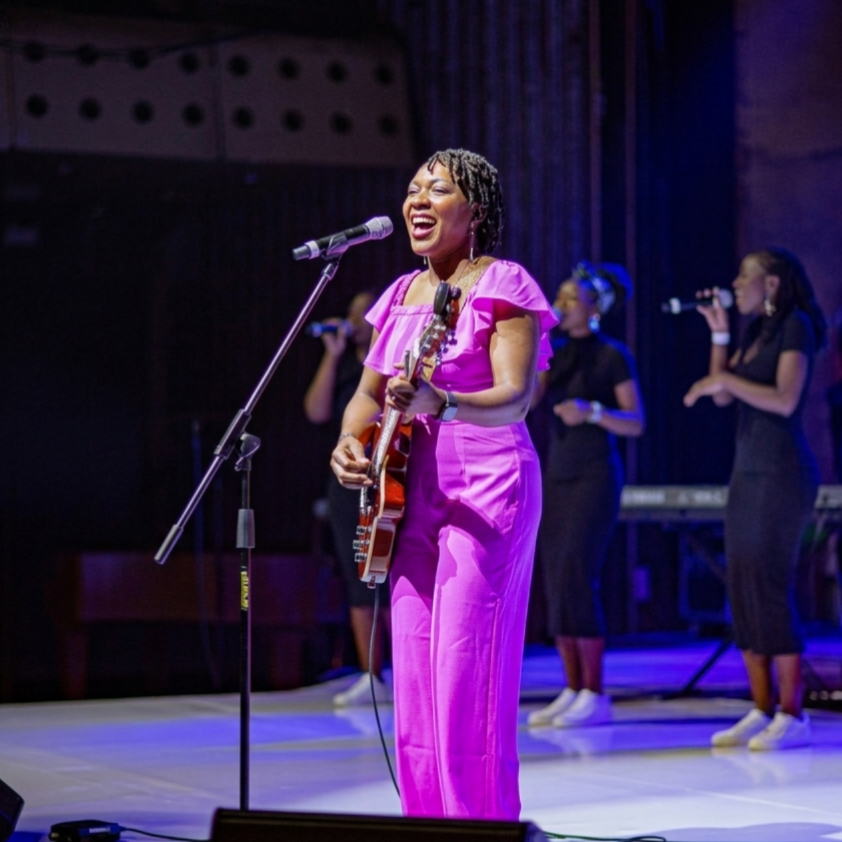
TJ: Your name — Tariro neGitare — tells the world you are joined at the hip with your instrument. But after more than a decade in the industry together, has your relationship with your “partner” changed?
TG: It’s definitely evolved. In the beginning, I felt like I had to prove I could play — you know, that “girl with a guitar” curiosity. I was Tariro and the guitar. Now, after a decade, the “and” has disappeared, but I’ve realised there’s a beautiful distinction. There is Tariro, the person, and then there is “Gitare”, the gift. The gift is what brings me before kings; it’s the tool that allows me to shine for Jesus. I’ve grown to realise that while the guitar is part of my identity, it is ultimately a vessel for a higher purpose. It’s a much deeper, quieter kind of love now — one rooted in stewardship.
AG: To me, your music does have that “deeper, quiet love.” It often feels like a warm, introspective conversation. How do you write such intimate songs?
TG: I’ve never been one for those long, indulgent solo types (laughs). To me, the song is the conversation. When I write, I usually start with a feeling or a specific “vibe” I want to share with a friend. I try to keep the arrangements stripped down because I want the listener to hear the lyrics and the emotion behind them. If there’s too much noise, too much going on, the intimacy gets lost. I want you to feel like I’m sitting right across from you in your living room, just sharing a piece of my heart.
TJ: You seem to thrive in that communal setting. I read somewhere that you prefer the “artist collective” method, where creatives feed off each other in a shared ecosystem — much like the old Book Café days.
TG: We’ve lost some of those physical “melting pots”, like the old Book Café, where a poet, a lawyer, and a musician could all sit at one table and spark an idea. We need more hubs — physical spaces that are affordable and accessible, where creatives can just be. Digitally, we’re getting there, but we need more platforms that bridge the gap between “making art” and “making a living” — spaces that teach the business of the craft, not just the performance.
AG: Is that why you shifted from being “just” a musician to a builder of cultural infrastructure — Magitare Africa Trust and the Jacaranda Festival? Should artists build the industries they work in?
TG: Absolutely! In our context, you can’t just be an artist; you have to be an architect. If the stage doesn’t exist, you have to build it. If the business side is messy, you have to help clean it up. That’s why things like the Jacaranda Music Festival and Magitare Africa are so important to me. We have so much talent in Zimbabwe, but talent without infrastructure is a tragedy. If we want the next generation to thrive, we have to build the systems that support them.
TJ: I also like your other initiative — Khuluma Culture. It focuses on the preservation of oral traditions and indigenous languages, right? What Zimbabwean proverb or saying do you find yourself returning to here and there?
TG: I find myself thinking about the proverb: “Mbudzi kudya mufenje, hufana nyina” (a kid that eats the cabbage tree leaves is just like its mother). In everything I do, whether it’s on stage or running festivals, I’m reminded that people — especially the younger ones coming up — are watching. They mirror what they see. If I want a creative industry that is professional, disciplined, and full of integrity, I have to be that first. As a leader, you have to be exemplary because the next generation will only go where you’ve paved the way.
AG: Lastly, on the notion of setting examples: you hold a BSc in Sociology and Gender Studies (from the Women’s University in Africa), and you often speak about the “Musha Mukadzi” philosophy. So I have to ask: if a young Zimbabwean girl picks up a guitar tomorrow, what is the very first thing you would tell her?
TG: If a young Zimbabwean girl picks up a guitar tomorrow, the very first thing I’d tell her is to never separate her craft from her character. I’d tell her: “Let the music you make be a reflection of the woman you are becoming. Don’t just learn to play the notes; learn to lead with grace.” I want her to know that her guitar isn’t just an instrument — it’s her voice in a world that needs the wisdom and nurturing power that only she can bring.
While Tariro’s origins are rooted in the ephemeral magic of a live set, her current era is defined by the permanence of the platform. By synthesising performance with industry-building, she embodies a broader African recalibration — one where the creative act is inseparable from the construction of the festivals, labels, and institutions that house it. She has transitioned from the lone troubadour to a cultural architect, proving that in Zimbabwe’s evolving landscape, a guitar is not just an instrument — it is a blueprint. Her work mirrors a continental shift: a new vanguard of African creatives who are no longer waiting for a seat at the global table. Instead, they are building new platforms, turning melody into movement and individual art into an enduring, self-sustained community.
Follow Tariro neGitare: @tarironegitare
Photographs by Rodney ‘The Protege’ Gumbo: @rtututu

