What does it mean to create art on your own terms — rooted in your expressions, found culture, and sensibilities?
Introduction and conversation facilitated by Alex Gwaze (Curator)
This was the question I sought to explore by bringing together multimedia artist and curator Creative Sajeni with rising anime creator Cherhyuga. Their practices engage with contemporary and often niche art forms within the Zimbabwean context. While many still associate local art with sculpture and traditional painting, these two artists are exploring digital media, installations, and global subcultures—forms that speak directly to the lived realities of ama2K. Yet both embody a commitment to cultural authenticity and creative self-determination, even as they remain misunderstood in some mainstream circles.
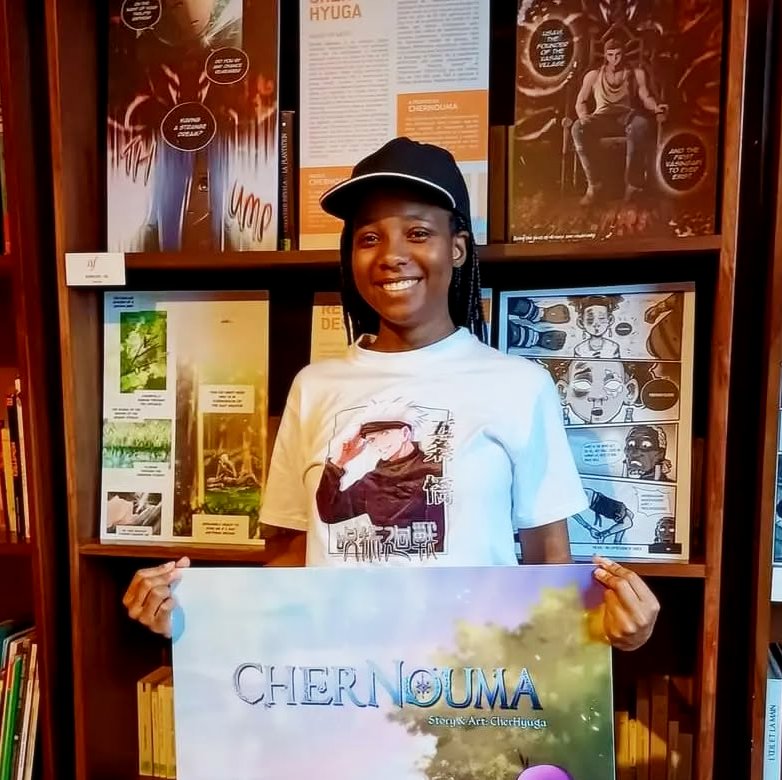
Firstly, we turn to the work of Cherhyuga (Lizzie Cherise Waldman), a dynamic animator, conceptual artist, character designer, and motion graphics designer based in Bulawayo. Specialising in anime-inspired digital art and storytelling, she is the creator of the webcomic series Destiny Indeed. Her work fuses global anime aesthetics with local themes, creating a distinctive niche within Zimbabwe’s creative scene. A passionate community builder, she launched Bulawayo’s inaugural Anime Day at the National Gallery of Zimbabwe. Her ventures also include Cherhyuganime, a brand dedicated to anime-themed art and fashion, and Anime Anime Anime, a platform for local anime enthusiasts.
On the other side we have Creative Sajeni (Paidamoyo Edgar Sajeni), a Zimbabwean polymathic artist and graphic designer based in Harare whose work spans multiple disciplines within the visual and creative arts. He is the director of Artistica Connect, a platform dedicated to fostering collaboration and networking among creatives. Since 2014, he has exhibited in key spaces such as the National Gallery of Zimbabwe (Harare), Artillery Gallery, Gallery Delta (now Nhaka Gallery), Art for Hope, and the Chitungwiza Artists Collective. His contributions to the arts have been recognised with an Outstanding Achievement Award from the National Gallery of Zimbabwe.

In their candid conversation, they reflect on artistic residencies, grief, the importance of community, and navigating cultural expectations while breaking into global spaces. This excerpt of their conversation explores what it means to create authentically as a Zimbabwean artist. Both creatives share their journeys, challenges, and inspirations — offering insights into how art becomes not just expression, but a tool for healing, resistance, and connection with community.
EXCERPT:
SAJENI: I combine art, semiotics, and design to create innovative and thought-provoking experiences. It allows me to tackle complex challenges with creativity and nuance.
CHERHYUGA: A lot of great things you’re doing! I’m particularly interested in the Animal Farm artist residency. Could you tell me a bit more about it and your experience there?
SAJENI: The Animal Farm is located on the outskirts of Chitungwiza — quite removed from the fast-paced city life, crowds, and noise that come with the urban environment. Admire Kamudzengerere founded and runs the project. I had been in conversation with Admire for about a year. My grandmother passed away in late 2021. I went into depression and really needed a quiet place to process my grief and release everything I was feeling. In October 2022, I went to the Farm.
CHERHYUGA: Sorry for your loss.
SAJENI: Thank you. I feel like the Animal Farm artist residency was a kind of lifeline. It was essentially a therapeutic retreat that turned into a six-month residency. I was joined by three other artists — Evans Mutenga, Clive Mukucha, and Tinotenda Chivhinge. We had to cook our own meals, tend the garden, and engage in daily conversations without the distractions of television. Despite the internet being available, it wasn’t a bother like it often is at home. We also had the opportunity to engage with the local community, connecting with nearby farmers. It was a lot of fun and gave us great insights into how people in Chitungwiza live and do business.
CHERHYUGA: I went to Chitungwiza sometime last year and I must say, it was a very refreshing place for me. A lot of people didn’t get it when I said that, but I just loved how strong the sense of community was.
SAJENI: The creative community in Chitungwiza is vast and rich with history. Being at the farm for such a long period helped me process everything I needed to.
CHERHYUGA: I get that. Especially taking a break from gadgets and distractions — just enjoying the present. Back home in Bulawayo, most of us don’t know our neighbours very well, if at all. So seeing people in Chitungwiza communicate with one another, share meals, stories, and time — it was truly refreshing.
SAJENI: I feel like Chitungwiza hasn’t been celebrated enough in that light compared to other creative centres like Bulawayo, Binga, Harare, or Mutare. Chitungwiza thrives on community and being highly unconventional. You’ll notice more upcycling and recycling there than in most places in Zimbabwe—largely due to the lack of funding and the absence of creative infrastructure that exists elsewhere. That has pushed Chitungwiza to birth movements, collectives, and stables. Imagine a city that hosts one of the biggest sculpture centres outside Tengenenge and Chapungu Sculpture Park, with a plethora of international artists in both the visual arts and music industries.
CHERHYUGA: You know, Bulawayo doesn’t have all the kinds of activities I’d love to explore. For instance, cosplay is still new to Zimbabweans. We rarely dress up as superheroes or characters. It’s a field that’s barely been explored — not because it’s wrong, but because we never imagined doing it. I used to travel to Harare just to attend such events. So I’m really glad it’s finally catching on — for those of us who’ve always wanted a chance to shine.
SAJENI: Congrats on your Anime Day event! I saw some amazing things. I wish I could’ve attended. The city has been calling me for a while now. Hopefully, God willing, I’ll be touring Skyz for a season.
CHERHYUGA: Thank you! It was a major milestone in my artistic journey, hosting an anime event in Bulawayo and turning my dreams into reality, one step at a time.
SAJENI: What was the most exciting or unexpected part of the day?
CHERHYUGA: Honestly, it was the positive response to the announcement. I was surprised by how many people were looking forward to it. It made me anxious — I really wanted to deliver. I put so much pressure on myself to make everything perfect for a first-time event. Things did get messy on the day, but somehow it all worked out. Looking back, a lot of the stress came from my own high expectations. Despite that, it turned out amazing.
SAJENI: From the pictures I saw on social media, it looked like it went really well.
CHERHYUGA: Thank you! It was incredible—and I honestly didn’t expect so many people to show up. We’re definitely going to do it again. It really surprised me how many people out there are looking for a space to express their love for anime and feel understood.
SAJENI: Finding your community is key to personal growth. Congrats again on your event—I’m looking forward to the next one.
CHERHYUGA: You should definitely come! Thanks so much for the congrats. I’ll do my best to make the next one even bigger and better. And hey, share some tips with me — you’ve curated several exhibitions, haven’t you?
SAJENI: Setting up solo projects isn’t easy. Come to think of it, group shows face challenges too. The hardest part for me has been the project build — putting together a body of work that resonates with people from all walks of life. But bridging cultural and historical divides is priceless. Creating a movement and leaving a mark on your nation — that’s something money can’t buy. One tip that works for me is always focusing on the next project. I make sure to connect it with previous work, focus on design processes, ideation, prep work, and meeting with curators, galleries, and partners. Once an exhibition is over, it’s time to reflect and move on. Just remember—it’s always best to be as authentic as possible, driven by action and collaboration, and to take time to unlearn just as much as we learn.
CHERHYUGA: Where do you get your ideas or inspiration from?
SAJENI: For me, the creative industries —especially art — have been a way of life since childhood. I grew up with a polymathic view that art could serve as a foundation for most career paths. I’m invested in history and currently pursuing legal studies, but art is my anchor. I’ve been exhibiting since 2014 — at the National Gallery of Zimbabwe, Artillery Gallery, Gallery Delta (now Nhaka Gallery), Art for Hope, Chitungwiza Artists Collective, just to name a few. And you?
CHERHYUGA: I’m mostly into anime like Attack on Titan, Summertime Render — the kinds that keep you guessing. I also read manga, Korean and Chinese comics. But I’m not a big fan of live-action adaptations of anime; it’s just not my preferred medium.
SAJENI: So you’re really all about anime?
CHERHYUGA: Not only anime, but like you, it’s my foundation. My real name is Cherish Waldman, but my artist name is Cherhyuga. It combines the “Cher” from my name and “Hyuga,” inspired by Neji Hyuga — my favourite anime character from Naruto.
SAJENI: Why that character?
CHERHYUGA: Neji Hyuga really moved me. He was hurt and angry from his past, but he grew into one of the kindest, most amazing characters in the series. That development inspired me. I’m a huge anime fan, and my artistic journey began when I was 15. I wanted to recreate the amazing visuals I saw in anime, so I practised digital art and animation.
SAJENI: How did you start creating your own anime?
CHERHYUGA: I realised my talent for animation when I ranked 12th in a global animation contest out of over 20,000 entries. That pushed me to keep going. In 2021, I also started making comics. My artistic journey has taken me to some amazing places — residencies, showcases, exhibitions. But these days, I’m more focused on showcasing my work internationally and have distanced myself from the local scene.
SAJENI: You’re not doing any local work?
CHERHYUGA: Honestly, I had a bit of trauma from how locals rejected my art style when I was younger. That constant rejection really broke me. So I cut ties, even kept my identity anonymous for a while.
SAJENI: I understand. One thing I love about art is how it helps with grief and trauma. I went through an intense emotional process, working for hours or days on a canvas that captured my feelings. Having conversations that promoted vulnerability helped me express what I was going through—it led to healing.
CHERHYUGA: Going international has helped me find healing too. Out there, people don’t care where you’re from. If they connect with your story, they follow it. Locally, people love stories — until the person telling them doesn’t look like who they expect. A lot of local creators face backlash when their characters aren’t “typically African.”
SAJENI: It takes a certain level of pain and commitment to go against the norm, and often against your parents at the beginning of the journey. It’s daunting — being alone until salvation comes.
CHERHYUGA: Exactly. One of my inspirations is Hajime Isayama, the creator of Attack on Titan. That story is set in a very Western context, outside Japanese culture, but it’s one of the greatest anime stories ever told. It still represents Japan — because he’s Japanese. That’s how I want to be seen: as a Zimbabwean telling great anime stories.
SAJENI: Your own stories, not necessarily “Zimbabwean” stories?
CHERHYUGA: Yes. I want the creative freedom to tell stories without being expected to represent a culture I haven’t been fully immersed in. I’m mixed race, which already brings its own complications. People often ask me to create stories about Lobengula, Tshaka, rural life — things I don’t feel equipped to represent authentically. I want to create for me, for everyone, using the tools of the genre I love.
SAJENI: I get that frustration — being under pressure to represent a political or cultural agenda. Issues like race, black tax, gender, or Ubuntu are complex and differently understood, even by those who promote them. But don’t be discouraged. You are perfectly positioned to tell your stories — authentically and fully African. You were born and raised here. You deserve to communicate the values and philosophies that shaped your life. I belong to a hybrid society too, one that resists historical distortion. But the fact that you’re telling your stories is enough. It allows you to draw from your personal experiences and take pride in your history, regardless of any backlash. People always connect to authenticity—the true core of a person’s identity.
CHERHYUGA: Thank you for that. We should collaborate on something.
SAJENI: Yes, it would be great to showcase your work locally. Let’s make it happen.
CHERHYUGA: I’m looking forward to it.
Follow Cherhyuga at: @cherhyuga and Sajeni at: @creative_sajeni_official
 MUD Journal