There was a time when guitarists were heroes and everybody waited for that Jimi Hendrix, Eric Clapton or Jimmy Page solo.
Words by Alex Gwaze (Curator)
Facilitated by Alex Gwaze and Zaza Muchemwa (Writer & Director)
The first time a guitar solo jumped out of a song and bite me was Allen Collins’ playing in Lynyrd Skynyrd’s “Freebird”. His solo made me think of that Robert Johnson ‘crossroads’ legend and price of skill. However, these days (thanks to Hiphop) you don’t have to be a skilled musician to stand out. The digital drums and electronic bass have pushed guitar players right out the song and into obscurity.
But there are moments in Hiphop, like in Kanye West’s “Devil In a New Dress”, where Mike Dean’s guitar makes a welcomed appearance. And there are those occassional live gigs where you can actually hear and see the guitarist. I was watching a live performance (the other day) and I suddenly realised, “damn the guitarist is carrying this act” (I mean that in a good way). The guitarist who was doing the heavy lifting was Kinah The Music, and the act he was ‘spicing’ / accenting shall not be promoted by me. However, another local guitarist I immediately thought of while listening to Kinah, was ‘the Serpant’. My mind started thinking about what these two could talk about when we put instruments back into the conversation.
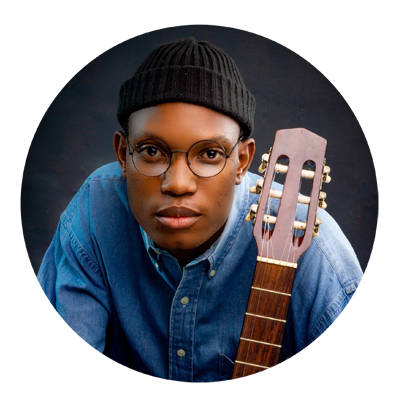
So I initially contacted singer, session guitarist, songwriter and poet, Kinah the Music (real name Shekinah Nathan Ndlovu). Kinah is a National Arts Merit award (NAMA) winner who has played with Vuyo Brown, Holy Rey, Selmour Mtukudzi, Jeys Marabini, Tariro NeGitare, Msis’kay, ASAPH, The Outfit Band, and more. Plus he has performed at Coca Cola Unplugged Zimbabwe, Zimbabwe International Trade Fair (ZITF), Jacaranda Festival, Intwasa Arts Festival, UN Virtual Concert, European Film Festival Zimbabwe, and the Festival of Lights. Kinah recently released his first EP titled “Music and My Feelings” and he is working on debut LP called “Valentines In December”.
Next I called the ‘Serpant’. Serpant is the frontman for a local rock band called Curfew At Midnight, and the guitarist for an experiment New Jit Wave band called Bantu Spaceship/s. Serpant has performed at Coca Cola Unplugged Zimbabwe, Fabrik Party, MTN Bushfire Festival in Eswatini, Malafala Festival in Mozambique, and Transmusicale Festival in France. His band, Curfew At Midnight, is currently working on their first LP.

Kinah and Serpant had never met before, but in the conversation they talked about masks, back seats, curio-music, chaos, emotions, big cities and Sungura.
SERPANT: I’m the Serpant (laughs). My real name is a bit of a public secret, I like the idea of people not quite knowing who the person behind the mask of the performer is.
SHEKINAH: (laughs)
SERPANT: (laughs) But I can tell you some info. I grew up in Gweru, spent a brief period of my life in Bulawayo and now I live in Harare.
SHEKINAH: The three big cities in Zim! Quick one – do you have a local guitar hero?
SERPANT: My favourite local guitar player is Andy Brown. I’ve learnt a lot from his work as a player that I’ve used in my own way, more so in Bantu Spaceship. I got a chance to know him in my youth too because he was friends with my dad. What are some of your guitar influences?
SHEKINAH: Locally for me it would be Hudson Simbarashe, Sam Siwela and recently Matthew Ngorima. I’ve gotten the privilege to play with the first 2, while also I have attended their shows. Hudson has a fusion of Trade and Blues, while Sam and Matthew have the Jazz, contemporary and new school type of vibe.
SERPANT: Oh wow! To play with your heroes is the dream for a lot of us.
SHEKINAH: Bro you can say that again! Doing a tour with Mai Mwamuka was a highlight for me also, cause literally the privilege and honour to not only play for an award winning artist was dope, but playing with musicians who are way better and more experienced than me is, you know.
SERPANT: That’s really awesome man! I would love to play with Salif Keita and Ali Farka Toure. I like that African sound but I’m heavily into rock. I’m very big on 70s metal and hard rock and the old soul guitarists. Also, Jimmy Page from Led Zeppelin, Prince who is my all time musical hero. Nile Rodgers from Chic, Josh Homme from Queens Of The Stone Age, Dave Navarro from Jane’s Addiction, Tony Iommi from Black Sabbath. Also punk rock guitarists like Greg Ginn from Black Flag, Ian Mackay from Fugazi, Jack White or even old school blues guitar heroes like Junior Kimbrough. And BB King and Muddy Waters. I play mostly blues guitar in my band Curfew At Midnight, but my musical sensibilities are affected by the requirements of the projects I undertake. And in Bantu Spaceship, a significantly more African sound is required of me and that’s also made me delve more into Sungura and Jit.
SHEKINAH: I fully get you in terms of project requirements and parameters. I’m more influenced by Jazz , RnB, NeoSoul. The guitarists that influence me from all over, in no particular order are: Jen Larsen, Kerry 2 Smooth, Jimmy Dludlu, Kazuki Isogai, Tom Misch, Melanie Fay and Mzizi Mthinteka. Honestly, Jimmy Dludlu (cause of his style of play) inspired me to dabble more into guitar because he made the guitar speak. I even got the nickname Jimmy cause I’d try and play his solos and his songs every chance I get (laughs). Even when I wasn’t nailing it I would persist (laughs). I don’t play that much Sungura or Jit though.
SERPANT: I think Sungura needs to evolve to suit the times. For example, I play Sungura guitar for Bantu but the band has electronic beats. I think to allow for the genre to exist and thrive in the times it has to evolve with the times.
SHEKINAH: Well for me I feel firstly the fans of Sungura never passed on the music to the new generation plus it never evolved from the beer hall. Yes they play at stadiums and other places but today it’s more big or followed mostly by beer garden lovers. Maybe it’s because it is played there a lot. Plus I feel the new school didn’t inherit it well and even try to grow it, and for lack of a better word, improve it. Like create new body of works with this genre like Hiphop went Jazz, New Jack Swing. Boom Bap, Conscious, Trap, Neo Soul, Chipmunk Soul and Drill.
SERPANT: You have to acknowledge Tanto Wavie, his done a good job of keeping Sungura alive for the youth with his Trap Sungura hybrid. But I should mention that when I was a small child I was very much obsessed with the music of Tongai Moyo and it still has my ear now as an adult – so long anecdote short, I like Sungura guitar and hope it finds a way to continue to exist.
SHEKINAH: Alex asked me if I think the youth have lost the ear for guitars in general. They seem to be into drums and ama piano he said. No room for solos (laughs).
SERPANT: (laughs) I don’t believe the guitar solo has lost the ear of Zimbabweans because Zimbabweans still think that a live act should play guitars regardless of what genre they perform in. Having a live band is still considered the true mark of professionalism for a real artist. And that’s everywhere. A lot of musicians are using live bands. So I don’t think the guitar has lost its place in the psyche of the people.
SHEKINAH: I will agree since we are both guitarists, we will be biased (laughs).
SERPANT: (laughs) Yes, but really if we were to take the idea that there’s not a lot of guitar music on the radio, then okay he has a point. But I think it’s because most music is now being produced on computers which don’t necessarily require as much time to learn how to use to produce music as learning an instrument does. But the music does have guitar samples. And some rappers even call in session musicians.
SHEKINAH: Yes I have played on several live Hiphop performances and recording sessions.
SERPANT: But wait! Lets talk Bantu Spaceships. It’s considered an underground act because of the unusual and experimental combination of disparate sounds in Jit, Sungura with Electronica/New Wave music. But I foresee very big things for this sound.
SHEKINAH: You just reminded me of Dj Clock and Beatenberg’s “Pluto (Remember You). But I think in South Africa they call that sound Maskandi. Now that I think about it, the guitar didn’t lose the ear per se but it became more dominant in certain areas and genres in Africa, like Sungura, Rumba, Jit, Ndedera, Trade, Ndolwane, and Maskandi. And if you look at what these genres have in common is the artists themselves get famous in that specific part of the country or city. It’s like they are the village heroes.
SERPANT: Makes sense in terms of localizing the sound. But you know there’s a need for collaborations in the digital era. I consider my role in Bantu as a collab. It’s very different to my role in Curfew At Midnight. I play the lead guitar in Bantu. That’s what I wanted to do when I started playing music. To play guitar in a great cutting edge band. Meanwhile in Curfew At Midnight my role is more of guitar wielding party starter. Curfew is a party band essentially and I think of my role as more of master of chaos and storyteller than anything else when I’m in that band (laughs).
SHEKINAH: I love that feeling of establishing your own role in your music. I’ve been making my own music. Made an EP now working on my album.
SERPANT: Awesome. Tell me about your sound. What’s your sound like?
SHEKINAH: Well for me, Kinah The Music! I’m more Afro-soul fused with Jazz. RnB too, but there is a sound I’m going for, still trying to create, cause as it is I’m still experimenting and finding it. I think its a niche and even innovative genre. I think my sound is emotive. But you know, being a session musician, and playing for others can be taxing at times. Cause my own music suffers and takes a back seat, but the moment I decide to fully follow through on my work I come in fully armoured with that sound I’m trying to describe (laughs).
SERPANT: I hear you. You know what I enjoy the most about making your own music? The song writing! That’s really awesome. I always feel a sense of triumph when I finish writing a new song and I’m enjoying listening to the demo because I’m a fan of my own music. For some other songwriters, writing songs is a function of the job but to me it’s the point in and of itself because songs facilitate the experience of being an artist. Especially with songs for Curfew. It’s like an ice cream parlour or an arcade. You come to us for a good time. You know in the times we live in, even apolitical statements are political statements. Staying completely Switzerland artistically is even more important, I think.
SHEKINAH: Yeah a lot of artists are focused on “good time” music. But I want to create an identity and express myself and where I come from to the world. So that the day I pop people see my culture and individuality, as well as the great music I have created.
SERPANT: I get you, a lot Zim music is remaining underground because for the most part it’s friends making art for friends. There’s a few of us who are seemingly finding new avenues to bubble above ground and touch the world. We got talent here but the goal is to move out of curio territory of music into the pop stratosphere. We’ve seen artists in the past utilize African sounds like Paul Simon did on the Graceland album. It’s merely about finding a way to make the music paletteable to mainstream ears. I don’t think we are really thinking mainstream.
SHEKINAH: Yes! There is a lot of copying sounds and life styles rather than creating our sound to champion our authentic lifestyles. Creating the sound track to our lives like Country music is for Americans, Hiphop for Black Americans, and Kwaito for South Africans.
SERPANT: It’s embarrassing to say that I learnt how to play African music from an American musician (laughs).
SHEKINAH: The West does get the studying part done well. They learn the music, cannonize it and teach it very fast. We haven’t learnt how to do that effectively. We focus on creating trends (laughs). Honestly I am more Afrocentric than Eurocentric but my early influences were influenced by my uncle’s taste. Boyz II Men, KC & Jojo, Blackstreet, Joe Thomas. Growing up it was that mixed it up with Giveon and Masego. I learnt to like African music later cause there is just so much more American music out there.
SERPANT: Honestly there’s very little originality in some music compared to the Fela Kuti’s and Tuku’s. Tuku had Tuku music! Fela Afrobeat.
SHEKINAH: Burna blew up because he invented Afrofusion. We need to collaborate to create new genres in Zim not just remixes.
SERPANT: True! I’ve been thinking of some music for you to listen to during this chat.
SHEKINAH: Send it. I love hearing new stuff. It’s eye opening. But I got to run. But man, Alex, Serpant, Za, I’m super honoured and humbled. These conversations. It’s something new and refreshing. Meeting and talking like this.
SERPANT: Let me send some links to you and tell me what you think and talk more.
SHEKINAH: Thank you. Let’s do this again. I wish you all the best guys!
SERPANT: Thank you. This was awesome guys!
FOLLOW Kinah at @kinah_zw and Serpant at @the_serpant_official.
Contact MUD Journal at: MUD & CO
SUBSCRIBE to MUD Journal at: MUD Journal
DOWNLOAD your FREE COPIES of MUD Journal here.
 MUD Journal