Amplifying nature’s memory.
Words by Alex Gwaze (Curator)
Questions by Alex Gwaze and Zaza Muchemwa (Writer & Director)
The first thing I ever learnt to paint was a landscape. As a kid who liked to draw comic book characters like Spawn, Lobo, and Judge Dredd – being forced to paint trees, clouds, flowers and mountains, in the style of JM Turner, Claude Monet, or Isaac Levitan, was like waiting for a ZUPCO bus to arrive when you are already late. I needed movement – something man-made, a person, or ‘the personal’ like Caspar David Friedrich. I think inside me (and us) is this Western desire to conquer, tame and mark the wilderness. But as an African (who herded cattle during school holidays at my grandparents’ homestead), I inherently knew how to be still and behold the atmosphere of nature.
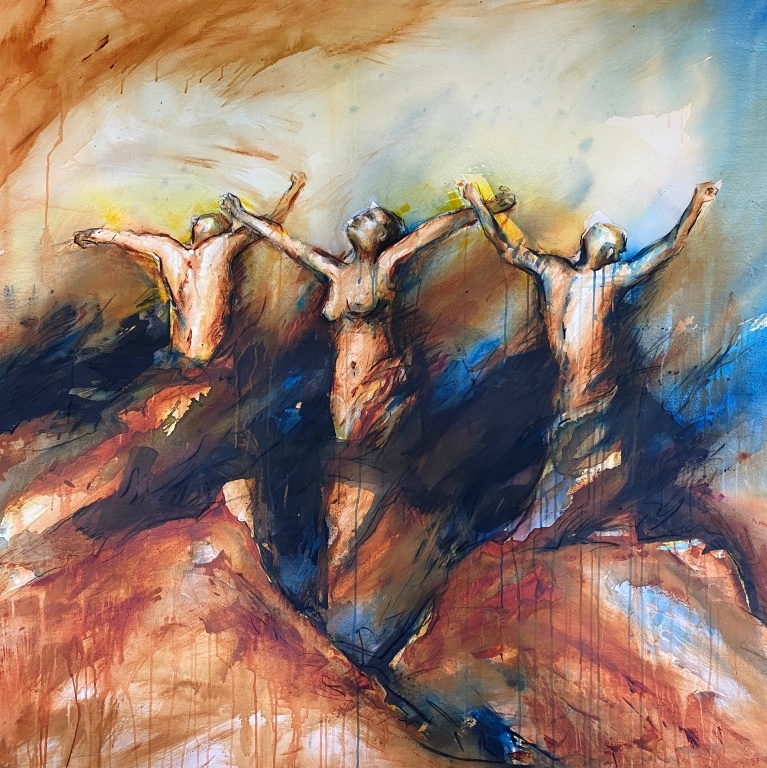
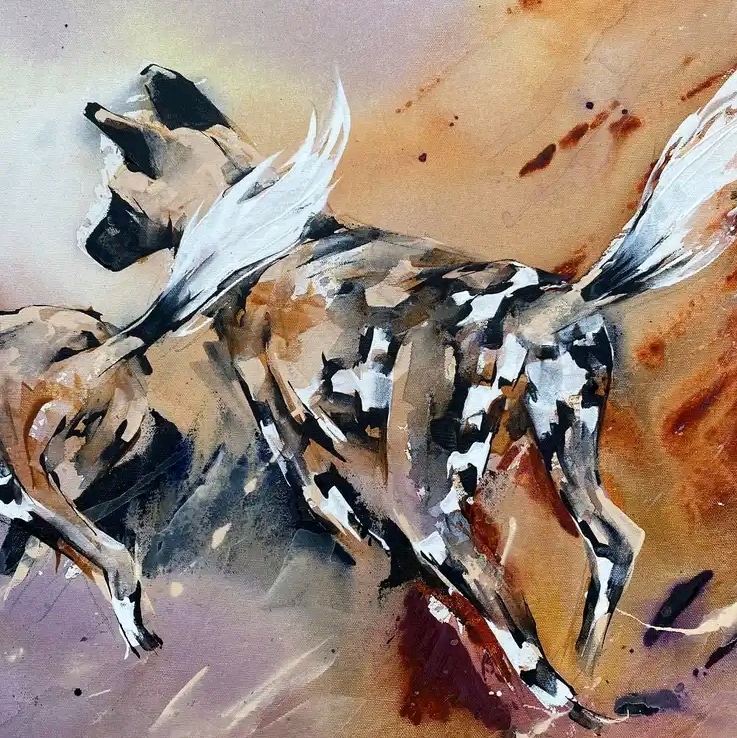
I found myself reflecting on this stillness versus movement conflict whilst observing the brush strokes on Lin Barrie’s artworks. Lin Barrie is an artist, writer and conservationist who has a diploma in Fine Art from Durban Art College. She also completed a Creative Writing course at the University of Cape Town, mentored by author JM Coetzee. Lin primarily creates abstract emotive landscapes that depict nature, people, fauna, birds, mythological figures, and more (sometimes all at once). Her work is colourful, immediate and observational, yet poetic and visceral. It reminds me of the promise of the landscape genre (let me expand).
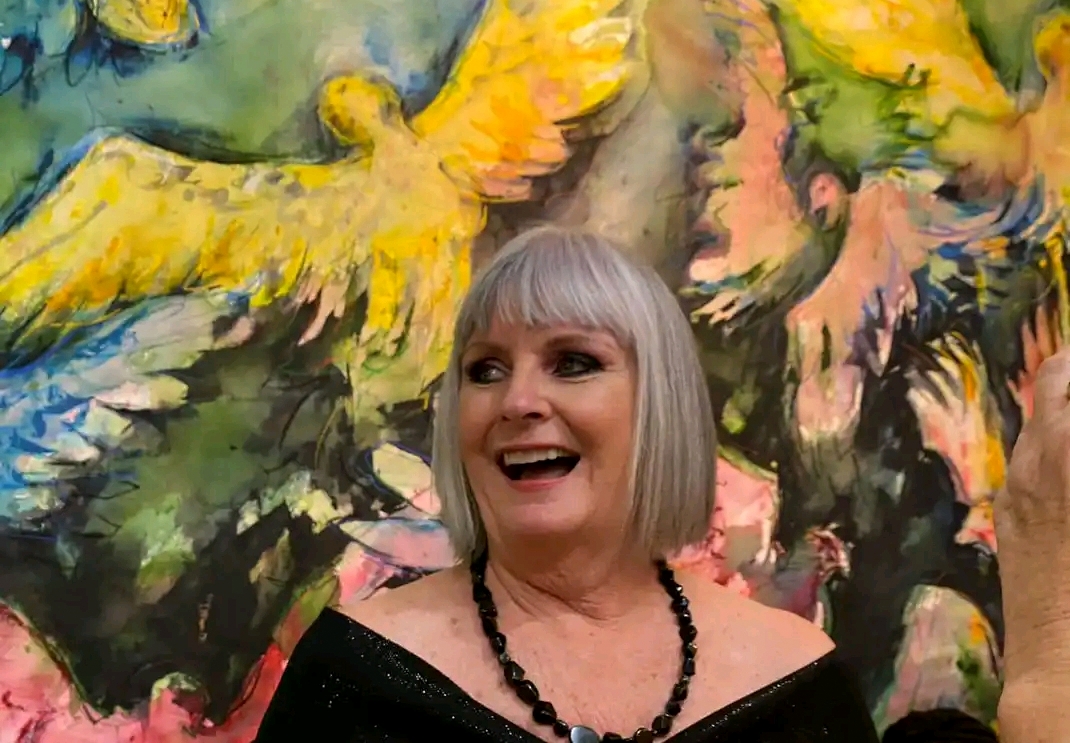
For me, landscapes are a timeless subject directly linked to the creation of our cultural identity. Places have a particular energy, knowledge, and memory. This is why we want to be photographed in certain locations. It’s our way of establishing an emotional connection to the space. And a tool to amplifying our imagination. This is what I believe Lin is doing with her works – extending her memory of the space into the spiritual realm of her hopes, dreams and fears. I cannot be 100% sure about my interpretations though. This is why we asked her some questions, to gauge how she has been inspired by the Zimbabwean savannah, fauna and flora.
AG: You live and work in a conservation area in the Zimbabwean lowveld. What do you enjoy the most about living in the wilderness?
LB: My constant is #AllThingsConnected. It reflects my ethos that no matter where you live, be it a city skyscraper, suburban town, rural settlement or wildlife area, there is a web of life to be understood, to be honoured. I am so lucky to live and work between three very interesting parts of Zimbabwe (Harare, Save Valley Conservancy and Chief Mahenye’s Village). Harare (H-Town) I love because it is my home town, where I was born. Its people are varied, locals and immigrants alike. The creative scene is so dynamic against all odds. And the climate is perfect, not too hot not too cold! As for Save Valley Conservancy (SVC) – I love, because it is a challenging slice of ecosytems that I resonate with, biology being a passion for me at school. In the SVC I am centred in the midst of elephants, African wild dogs, baobabs, lions, dung beetles and rhinos, and a magnificent landscape of rock kopjies.
ZM: You live with your life partner in the village, Conservationist, Clive Stockil. What’s it like being in a ‘none-conventional’ relationship amongst very rural Zimbabweans?
LB: Clive and I have been living together for 26 years, and most of our friends whether in town or in the rural areas, seem to naturally accept our long term commitment. We live in Mahenye Village, where we are lucky to live on a small piece of land under Chief Mahenye. It’s right on the border of Mozambique and the Gonarezhou National Park (Gonarezhou Conservation Trust, GCT). It’s a fascinating mix of rural living and wildlife which I find very satisfying. Embracing traditional Xangana cultural crafts, music and dance and Ngano (oral stories), together with vibrant people, and strong community conservation initiatives such as the newly formed Jamanda Community Conservation Area.
ZM: Sounds like a lovely area to live in. You moved from the conventional printmaking into none-objective or abstract forms of Art? Printmaking to me feels more repetitive and exact than the Art you are known for.
LB: Printmaking is a love for me! The linework of etching or the freer expression of monotypes is very satisfying. As is life drawing and strong habits of drawing instilled in me at college. It inform my art practice constantly. I feel like drawing is the cornerstone upon which any art practice can thrive, be it print, sculpture or painting. Monotypes are a large part of my art practice and can be very abstract depending on my mood.


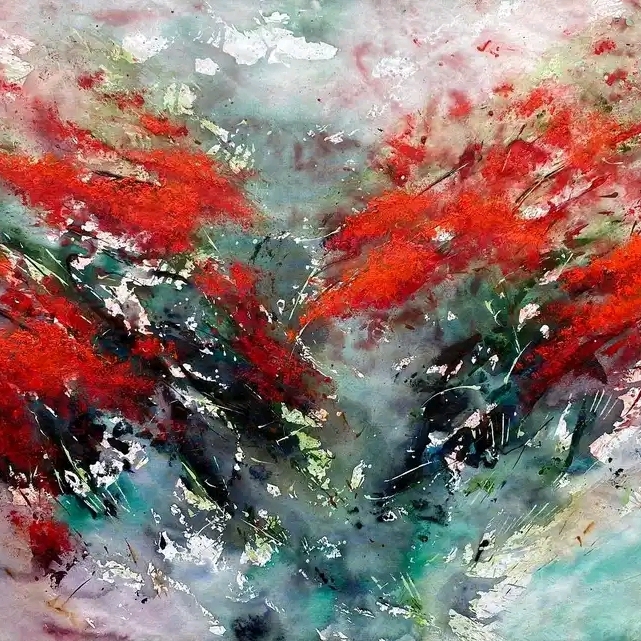
AG: Abstract Art is probably harder to sell than textiles. Do you ever feel the pressure to do some ‘picture making and paint works that are more commercial or easy to sell?
LB: Yes that pressure is real, especially in economically compromised Zimbabwe! The challenge is to not churn out repetitive commercial or ‘fashionable’ type works, as even if you do sell them, they are not guaranteed to hold their value! Somehow you must always strive to find your own artistic voice.
.AG: I used the term “Abstract Art” to describe your work. How would you describe it in your own words?
LB: I would say my art builds from field sketches and life studies (impressionist and figurative drawings and paintings), and works ideally towards abstract or figurative expressionist art. It is this #AllThingsConnected mantra of mine that informs my work, that inspires my art. Whether I am painting a night sky or an elephant, an expressionist abstract or people dancing, there is a connectivity between all humans and every growing thing, be it a tree, flower, giraffe, or insect!


ZM: A lot of Africans view Art as a past-time and don’t see the value of it. Just out of curiosity, how much did you sell your first painting for?
LB: It was back in 1990 when I sold my first small painting of a yellow billed hornbill to Patrick Mavros. For probably about US$150.00. Now that same quality / size quality painting would be about US$300 or 400.
AG: Patrick Mavros is another artist known for luxury African jewellery, wow! Good first sale. The art space must be very different from when you first started. How do you stay relevant in this industry which is always looking for the new kid on the block?
LB: The art scene in Zimbabwe, and indeed Africa, is hugely vibrant. The challenge for any artist is not to copy for success but to dig deep into developing an individual style. Perhaps my relevance is that I embrace the interconnectedness of art. I believe in collaboration and I value my friendships and collaborations with multiple artists over varied disciplines. One of the most important collaborations for me is with my daughter, Kelli Barker. Kelli is a make-up and body artist. The ongoing inspiration we share in creating our mutual art events is what truly keeps me relevant!
ZM: That mother-daughter bond is very important. I noticed that you are also branching out into creative writing, specifically blogging and poetry.
LB: I embrace the interconnectdness and the storytelling of art. So it seems natural to me that words arise from my emotions while painting, and paintings arise from my words! The two are interwoven in my mind, and often that then translates into film, or fashion garments or printed textile, depending on whom I am collaborating with. Textiles remain a huge interest for me, whether I am painting on pure cotton canvas, as finished stretched paintings, or loose cotton such as my collaborations with Spinweave. Or making marks on sustainable cotton garments such as those created in my collaborations with Haus of Stone.
ZM: I read some of your blog posts. The Baobab fruit recipes particularly stood out for me. As someone who lives between borders you must have tried some interesting foods. What’s the strangest thing you have ever eaten?
LB: Hmmm, strangest thing I ever ate were frogs legs in Hong Kong. But generally I prefer to eat non processed local foods wherever I am, believing that we all should know the source and the story of what we put into our bodies. Local foods, wherever you are in the world, are the best thing to eat in that circumstance. I love local fruits, honey, wild fruits, local grains such as sorghum, millet and sesame. Baobab powder plus Zumbani tea are daily components of our diet.
AG: You must have travelled extensively looking for the perfect setting to capture or ignite your senses. So, for my last question, I would like to know where do you feel most content?
LB: Which place have I visited and felt most content? A difficult question, as I love travelling and different cultures, so I feel at home in most places. but I do feel very at home in coastal Mozambique, the more rustic the better. However wherever I am, I always have an urge to create, I am always inspired by my surroundings. And wherever in the world I travel, Zimbabwe is truly where I feel most at home. Zimbabwe is always roots, always home sweet home.
Follow Lin Barrie at: @linbarrie
Contact MUD Journal at: MUD & CO
SUBSCRIBE to MUD Journal at: MUD Journal
DOWNLOAD your FREE COPIES of MUD Journal here.
 MUD Journal